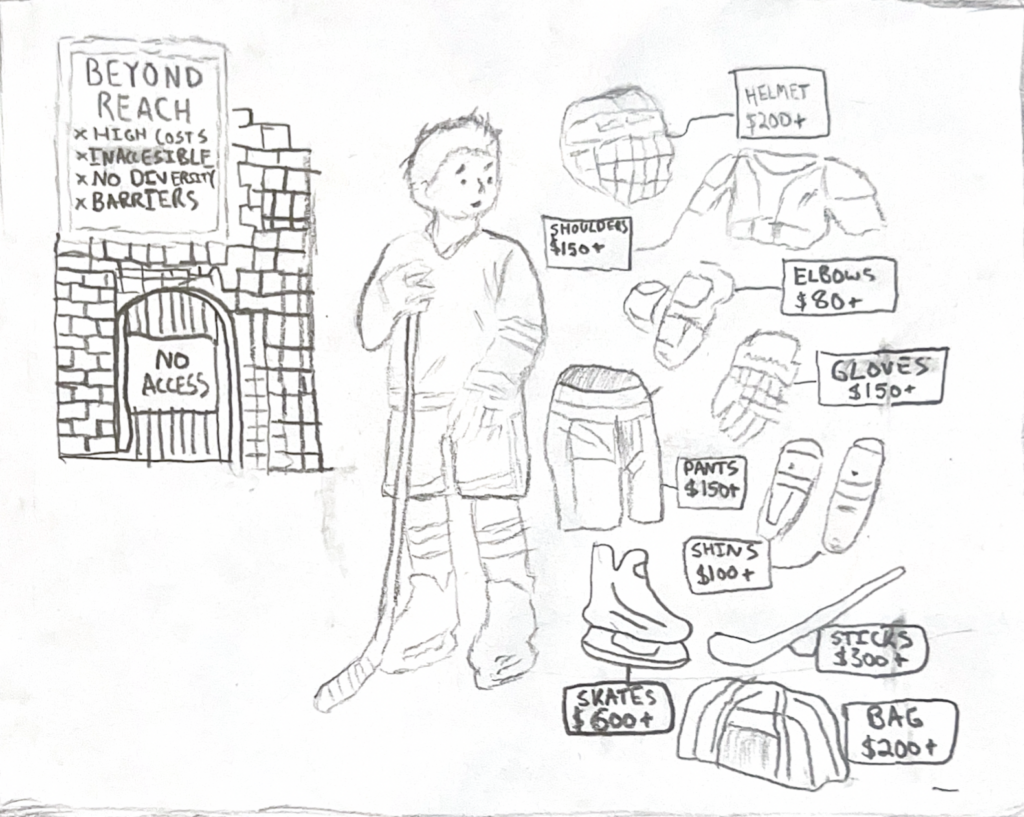
Hockey is one of the most expensive youth sports in North America. Even before a child begins playing, families must pay for equipment, ice time, and sometimes travel teams. Research shows that these costs add up quickly and put considerable pressure on families, turning hockey from a fun activity into a long-term financial commitment that many cannot afford (Cote & Murata 2022). As players grow older, the expenses increase. Beyond yearly equipment replacement, elite travel teams, private coaching, and specialized training programs have become common parts of youth hockey. Families often feel pressure to participate in these supplemental enrichment activities to keep their child from falling behind. Many parents worry that skipping a camp or not buying top-level gear will hurt their child’s chances of moving up (Pandya 2021).
Another major barrier is the lack of accessible facilities. Unlike sports such as basketball or soccer, which can be played almost anywhere, hockey requires refrigerated rinks and carefully maintained ice. These facilities are expensive to build and operate, so they are usually located in wealthier suburban areas. Many urban neighborhoods and rural communities do not have rinks at all, which means that geography, not just interest, determines whether a child can even try the sport (Armentrout & Kamphoff 2011).
Social and Cultural Barriers
Money is not the only factor shaping who plays hockey. The culture of the sport can also make some young athletes feel unwelcome. Studies show that hockey often emphasizes mental toughness, year-round dedication, and a willingness to take physical risks (Rohdal et al 2015). These values become central to a player’s identity inside the locker room (Burry & Fuset 2020). While these expectations can build strong team bonds, they may also discourage kids who cannot commit to constant training or who have different priorities.
Racial and ethnic barriers also play a significant role. In both the United States and Canada, hockey has long been viewed as a mostly white sport (Kabetu et al. 2021). Many Black, Indigenous, Latino, and Asian-American athletes report facing racial comments, exclusion, or the feeling that they do not fully belong (Sandrin & Palys 2021). These experiences reflect larger inequalities in access to rinks, equipment, and coaching.
As well as lingering racial prejudices, Black players continue to compose only a small percentage of NHL rosters, partly because many predominantly Black neighborhoods lack affordable hockey programs. Indigenous communities in Canada have a deep connection to hockey, yet they are also often left out of the hockey programs that lead to elite opportunities (Wong & Dennie 2021). These patterns show how structural inequalities limit who advances in the sport.
Efforts to Expand Access
Efforts to expand access remain limited and face a lot of challenges. Near the end of my high school career, I attempted to increase access to hockey in my hometown. I designed a blueprint for a camp that presented an opportunity for inner city youth to play at a local rink free of charge. I did not attract as much success and attention as I desired, however I was able to introduce one interested kid to hockey and teach him the basics.
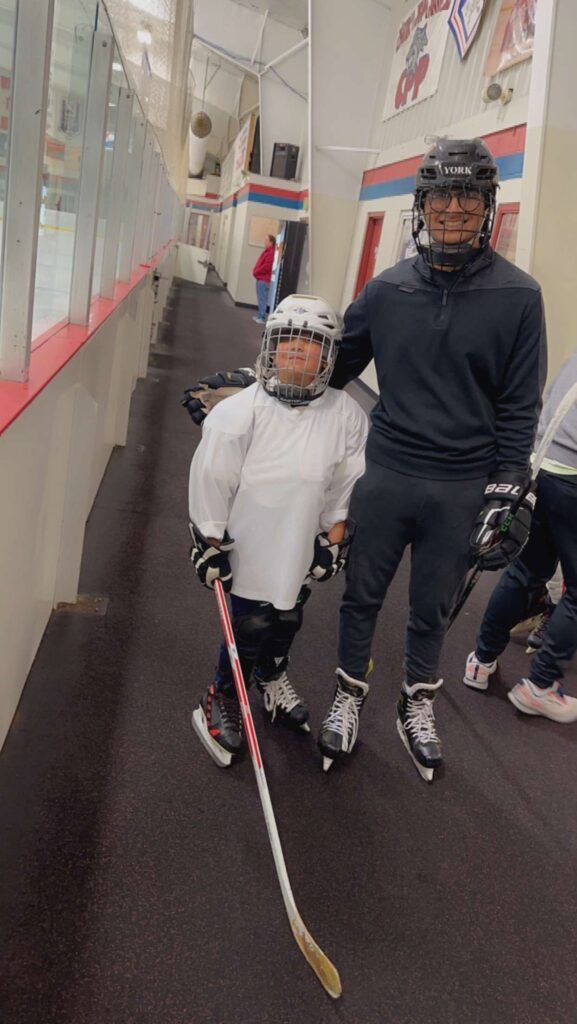
In response to these challenges, several organizations have worked to make hockey more inclusive. The Ed Snider Youth Hockey and Education Foundation in Philadelphia provides free equipment, coaching, and league play to children in under-resourced neighborhoods. Early program data shows that participants not only improve their hockey skills but also show stronger school attendance and engagement (Ed Snider Youth Hockey & Education 2025).
The Hockey Diversity Alliance (HDA), founded in 2020 by NHL players who experienced racism in the sport, funds programs that help minority youth access hockey and pushes the NHL to address discrimination. Early reports show increased participation and retention among Black and other minority youth in HDA programs (Wyshynski 2025). However, long-term success for this initiative depends on consistent funding and strong community relationships.
Hockey continues to remain as a meaningful sport for many communities, and the love of the game is widespread. However, recognizing the barriers that influence participation is an important step toward making the sport more accessible. Programs that reduce equipment costs, make rinks more accessible, or support local youth leagues can open the door for new players. The biggest challenge for many young athletes is not learning how to skate, it is actually getting onto the ice in the first place.
References
Armentrout, S. M., and C. S. Kamphoff. 2011. “Organizational Barriers and Factors That Contribute to Youth Hockey Attrition.” Journal of Sport Behavior 34 (2): 121–136
Burry, Evan, and John Fiset. 2022. “Calling the Shots: Organizational Culture, Performance, and the Commoditization of Ice Hockey Players.” Sport in Society 25(5):945–962. https://doi.org/10.1080/17430437.2020.1815708.
Ed Snider Youth Hockey & Education. 2025. 2025 Snider Impact Report. https://sniderhockey.org/wp-content/uploads/2025/04/2025-Snider-Impact-Report-Final.pdf
Kabetu, Victoria, Ryan Snelgrove, Kimberly J. Lopez, and Daniel Wigfield. 2021. “Hockey Is Not for Everyone, But It Could Be.” Case Studies in Sport Management 10 (1): 7–14. https://doi.org/10.1123/cssm.2020-0020.
Murata, Alex, and Jean Côté. 2022. “Considering the Cost(s) of the Game: Consumer Behavior and Parents in Youth Ice Hockey.” Journal of Applied Sport Psychology. https://doi.org/10.1080/10413200.2022.2098878.
Oatley, Keith, et al. 2021. “Sport Participation and Psychological Well-Being Among Youth.” Frontiers in Psychology. Retrieved from https://pmc.ncbi.nlm.nih.gov/articles/PMC8497066/.
Rodahl, Stein, Rune Giske, Derek M. Peters, and Rune Høigaard. 2015. “Satisfaction with the Coach and Mental Toughness in Elite Male Ice Hockey Players.” Journal of Sport Behavior 38 (4)
Sandrin, Ryan, and Ted Palys. 2022. “The Hat-Trick of Racism: Examining BIPOC Hockey Players’ Experiences in Canada’s Game.” Sociology of Sport Journal 39 (3): 278–286
Wong, Lloyd L., and Martine Dennie, eds. 2021. “Hockey in Canada: Indigeneity, Ethnic/Racialized Minorities and the Nation.” Canadian Ethnic Studies 53(3).
Wyshynski, Greg. 2025. “Hockey Diversity Alliance Turns 5: Challenges, Triumphs and Grassroots Programs to Eradicate Racism.” ESPN, August 16, 2025
