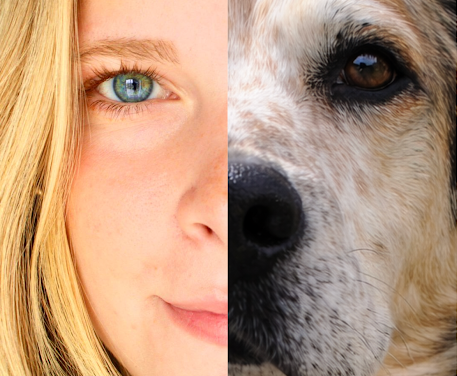
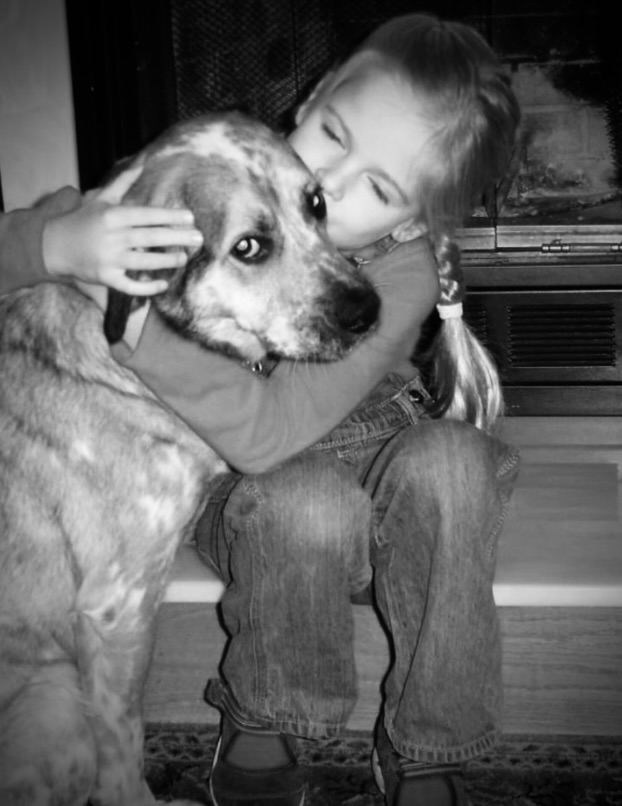
While many people credit an influential teacher or parent as a pivotal influence, for me, it was something different. For eighteen years, I grew up alongside Tabby, a scrappy rescue from the South who taught me how to be a better person. She helped me develop empathy and emotional awareness, and even influenced my career path. Yet, my story with Tabby goes beyond a sweet dog and instead reflects how relationships with animals, especially dogs, can expand one’s social consciousness.

Modeling Empathy Towards Others
Dogs can teach empathy in surprising ways. One time, Tabby ran over to get a treat, only to place it at the feet of our arthritic dog Maggie, who often struggled to get up. Watching a dog recognize another’s needs and give up something desirable was eye-opening
Sociologists and psychologists argue that empathy develops through socialization, particularly in early relationships and environments where individuals learn to recognize and respond to others’ emotions (Eisenberg and Morris 2001).
Relationships with animals play a key role in making people more humane. Interacting with pets provides repeated opportunities to practice care and emotional awareness, which can strengthen empathy and extend into human relationships (Christian et al. 2020). Research also finds a measurable link between empathy toward animals and empathy toward people, suggesting these forms of compassion are connected rather than separate (Cardoso et al. 2022).
Expanding Social Connection
Another benefit of owning a dog can be greater social interaction. In everyday life, interactions between strangers are shaped by unspoken rules. Walking down a hallway or sidewalk, people often notice someone in the distance but are not close enough to acknowledge them. Many look at their phones or the ground to avoid awkwardness. Sociologist Erving Goffman calls this “civil inattention,” the subtle way individuals acknowledge others’ presence while keeping their distance (Arminen and Heino 2023).
The presence of a dog, however, can change that dynamic.
Dogs act as social catalysts, turning moments of polite avoidance into natural engagement. Dogs often attract attention and invite interaction, prompting strangers to smile, stop, or start conversations. Observational research shows that people are significantly more likely to approach or talk to someone accompanied by a dog, suggesting that dogs facilitate spontaneous social connection and make interactions feel safer and more comfortable (Carr et al., 2021).
Over time, those small interactions add up. Walking with Tabby did not just change brief moments, it changed me. I became more comfortable starting conversations, more open to connecting with new people, and more aware of how a shared moment can break down invisible barriers. Research shows that my experiences are not unique. Spending time with dogs is associated with higher levels of social connection and community engagement, suggesting that people who spend time with dogs have more opportunities to interact with others and build social ties (Zhao et al. 2025).

Discovering Life’s Purpose
The relationships with those around a person can shape not only who they become, but also what they choose to dedicate themselves to. For me, my journey with Tabby’s health is the crux of why I want to become a veterinarian.
At 18, when Tabby’s health was in a steep decline, she was brought to the veterinary clinic where I was working, knowing it was time to say goodbye. In that moment, I realized that caring for a patient also means caring for the people who love them. That realization not only deepened my desire to become a veterinarian but also shaped the kind of veterinarian I hope to be, one who supports both animals and their owners with empathy and understanding.
This lesson extends far beyond veterinary medicine. Whether caring for pets, children, aging parents, or friends, these relationships shape the empathy, patience, and understanding people bring to those they support. In this way, experiences with animals often do more than teach people how to care. Instead, they help clarify a sense of purpose and influence the paths people choose.
Sociological research shows that interactions with animals can shape how people understand themselves and their roles, particularly in situations involving care and responsibility (Irvine 2004). Similar experiences influence people entering healthcare, social work, and other helping professions, where personal encounters with illness or caregiving deepen empathy and shape how they care for others (Serpell 2005). Even outside professional contexts, these moments teach lessons about compassion, resilience, and the ways relationships guide choices and values throughout life.

Life off the Leash
Tabby’s influence reaches far beyond the years spent together, showing how everyday relationships can shape how people see and respond to the world. While dogs are not the only source of social awareness, they offer a simple way to practice empathy, connection, and responsibility. What makes these relationships powerful is their ordinariness, as small moments like a walk, caring for another being, or a quick conversation create repeated chances to notice others and respond with compassion. Over time, these moments build habits that encourage people to engage and recognize connection. Whether through volunteering, spending time outdoors, or paying closer attention to animals, these interactions help develop empathy and remind people that caring for others is what makes them more human.
References
Arminen, Ilkka A. T., and Anssi S. M. Heino. 2023. “Civil Inattention: On the Sources of Relational Segregation.” Frontiers in Sociology. https://www.ncbi.nlm.nih.gov/pmc/articles/PMC10508291/
Cardoso, Sandra Duarte, Ceres Berger Faraco, Liliana de Sousa, and Gonçalo Da Graça Pereira. 2022. “Empathy with Humans and with Non‑Human Animals: Are There Differences Between Individuals Who Have Adopted and Those Who Have Relinquished a Pet?” Journal of Veterinary Behavior. https://doi.org/10.1016/j.jveb.2021.11.008
Carr, Deborah, Erika Friedmann, Nancy R. Gee, Carol Gilchrist, Natalie Sachs-Ericsson, and Lakshmi Koodaly. 2021. “Dog Walking and the Social Impact of the COVID-19 Pandemic on Loneliness in Older Adults.” Animals. https://www.mdpi.com/2076-2615/11/7/1852
Christian, Hayley, Fiona Mitrou, Rachael Cunneen, et al. 2020. “Pets Are Associated with Fewer Peer Problems and Emotional Symptoms, and Better Prosocial Behavior: Findings from the Longitudinal Study of Australian Children.” The Journal of Pediatrics. https://www.jpeds.com/article/S0022-3476(20)30025-1/fulltext
Eisenberg, Nancy, and Amanda Sheffield Morris. 2001. “The Origins and Social Significance of Empathy‑Related Responding: A Review of Empathy and Moral Development: Implications for Caring and Justice by M. L. Hoffman.” Social Justice Research. https://doi.org/10.1023/A:1012579805721
Irvine, Leslie. 2004. “A Model of Animal Selfhood: Expanding Interactionist Possibilities.” Symbolic Interaction. https://www.wellbeingintlstudiesrepository.org/acwp_habr/7/
Serpell, James A. 2005. “Factors Influencing Veterinary Students Career Choices and Attitudes to Animals.” Journal of Veterinary Medical Education. https://pubmed.ncbi.nlm.nih.gov/16421833/
Zhao, Jing, Mohammad Javad Koohsari, Jiuling Li, Yufeng Luo, Andrew T. Kaczynski, Gavin R. McCormack, Koichiro Oka, and Tomoya Hanibuchi. 2025. “Beyond Companionship: Psycho-Social Benefits of Pet Ownership.” BMC Public Health. https://doi.org/10.1186/s12889-025-23464-y
