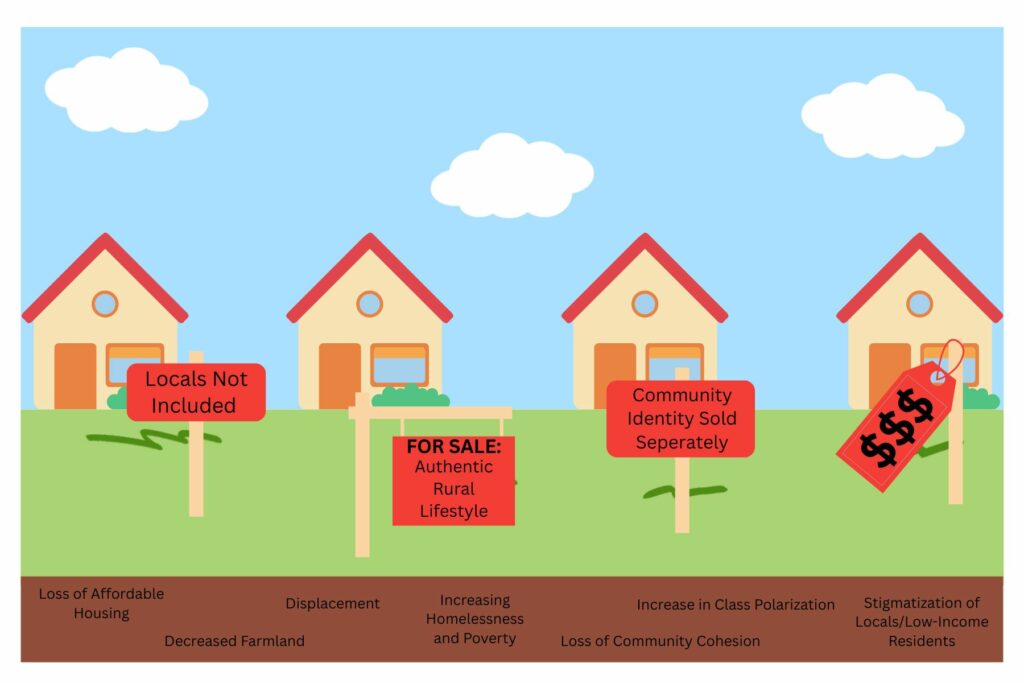
When I returned home from college in the summer in 2025, I was met with a completely different version of my hometown than the one I left. Gone were the expanses of open farmland and cornfields that had once defined Wooster, Ohio. In their place stood new mid-priced, high-density housing developments and large grocery store chains. Downtown, there were new trendy restaurants and expensive boutiques.

Like many other gentrifying areas, Wooster has had some unintended consequences of development that are emblematic of rural gentrification. Rural gentrification increases economic inequality through disproportionate access to housing. Small towns’ sense of a tight knit community can be lost as their community becomes more fragmented.
Rural Gentrification’s Exacerbation of Economic Inequality
Gentrification is defined by an inflow of affluent residents and investment into a neighborhood which incites an outflow of the low-income population (Yeom and Mikelbank, 2019). Although gentrification is a term often used to describe urban locations, gentrification in rural locations is common.
While gentrification can cause positive economic and social development for a small town, rural places are especially predisposed to several other harmful consequences of gentrification due to their limited housing supply (Golding, 2016). As the demand for housing increases, property values and rent increase, making it so that long-time homeowners, and especially low wage renters, struggle to afford to live locally (Sherman, 2023).
Gentrification in rural areas can also shift employment from traditional resource-based sectors such as farming. At the same time, leisure industries expand and second homes increase (Nelson et al. 2010). This combination creates additional housing shortages and widens the economic gap between incoming affluent residents and long-time locals.
Loss of Community
With rural gentrification, residents’ sense of a tight-knit, small-town community can be lost. For many, strong bonds between community members and social cohesion act as a protective factor in tough or threatening situations (Sherman, 2023). Long-time residents’ displacement disrupts the everyday relationships that sustain small-town life. Without consistent neighbors and familiar shared social space, residents lose the previous ability to rely on their neighbors, which can be critically important when other forms of support are absent. To make matters worse, many long-time residents are forced to move into low-cost housing such as mobile homes/trailers, which often do not have as strong of community ties (Sherman, 2023).
Social Division
Another critical impact of rural gentrification involves the creation of class-based fissures. Although community divisions manifest across all aspects of the community, they are particularly visible in the education system. As families move, children are shuffled between schools and districts (Golding, 2016). This creates new barriers to academic success for working-class children. Frequent school changes tend to increase the risk of poor achievement, having to repeat a grade level, and high school dropout. Children’s social relationships are disrupted as well; students who change schools are more likely to have smaller friend groups and to lose access to community and social resources (Herbers et al., 2013).
Additional social divisions are created between homeowners and long-time residents. Those pushed into low-cost or less stable rental housing can feel stigmatized and that their social reputation has been damaged (Sherman, 2023). Homeowners who move into a rural area often implicitly judge renters (Horgan, 2020). Privileged newcomers to rural towns may stereotype low-income locals’ real and/or imagined addictions, criminal behaviors, and “laziness”, which can rationalize their exclusion (Sherman, 2023).
Also troubling are the increases in homelessness alongside a small town’s growth in population. Rising homelessness can create even more divides in a community. Some people believe that the homeless should be fined for “loitering” downtown and disturbing merchants. The differences of opinion on how to treat homeless people can create conflicts between customers, business owners, and impoverished individuals (Bhatia, 2018).
Moving Forward: Offsetting Gentrification with Affordable Housing
The rapid transformation of Wooster and many other small towns serves as a reminder of what can happen when economic development masks the erosion of a small rural town’s social fabric. This transformation fuels increased socioeconomic segregation, misdirection of blame to families in poverty, and a community-wide loss of collective and individual identity, traditional jobs, relationships, and resources.
Moving forward, the rural gentrification crisis requires more proactive solutions. Since rural gentrification often causes longtime residents of an area to relocate, affordable housing programs that increase the supply of new housing and access to existing affordable housing should be put in place to serve these often low-income groups very early on in the gentrification process (Golding, 2016). In doing so, displacement of these vulnerable groups from areas that generate strong community ties and group cohesion could be prevented.
References
Bhatia, Kabir. 2021. “On the Streets: Wooster Considers Impact of Potentially Fining Homeless Population.” WOSU Public Media. Retrieved March 31, 2026 (https://www.wosu.org/wksu-stories/2018-12-10/on-the-streets-wooster-considers-impact-of-potentially-fining-homeless-population).
City of Wooster. (2023, March 15). Changing housing dynamics in Wooster [Presentation]. https://www.woosteroh.com/sites/default/files/2023-03/March2023_HousingPresentation.pdf
City of Wooster. (2024, October 3). Economic development plan: Silver Road tax incremental financing incentive district. https://www.woosteroh.com/sites/default/files/2024-10/TIF_SilverRdPlan_10.03.2024_FILED1028.pdf
Golding, Shaun. 2013. “Rural Gentrification in the United States 1975-2000: A Demographic Analysis of its Footprint, Impacts, and Implications.” Dissertation, Department of Sociology, University of Wisconsin, Madison.
Golding, Shaun. 2016. “Gentrification and Segregated Wealth in Rural America: Home Value Sorting in Destination Counties.” Population Research and Policy Review 35(1). Retrieved February 23, 2026 (https://www.proquest.com/socabs/scholarly-journals/gentrification-segregated-wealth-rural-america/docview/1757627273/sem-2?accountid=11264).
Herbers, J. E., Reynolds, A. J., & Chen, C. C. (2013). School mobility and developmental outcomes in young adulthood. Development and psychopathology, 25(2), 501–515. https://doi.org/10.1017/S0954579412001204
Horgan, M. (2020). Housing Stigmatization: A General Theory. Social Inclusion, 8(1), 8-19. https://doi.org/10.17645/si.v8i1.2345
Jones, B. (2018, November 27). Wooster considering ordinance to charge, fine homeless people who refuse shelter. News 5 Cleveland WEWS. https://www.news5cleveland.com/news/local-news/oh-wayne/wooster-considering-ordianance-to-charge-fine-homeless-people-who-refuse-shelter
Nelson, Peter B., Alexander Oberg, and Lise Nelson. 2010. “Rural Gentrification and Linked Migration in the United States.” Journal of Rural Studies 26(4). Retrieved February 23, 2026 (https://doi.org/10.1016/j.jrurstud.2010.06.003).
Sherman, Jennifer. 2023. “‘Please Don’t Take This’: Rural Gentrification, Symbolic Capital, and Housing Insecurity.” Social Problems 70(2). Retrieved February 23, 2026 (https://doi.org/10.1093/socpro/spab041).
Wayne County Auditor. (n.d.). Retrieved April 21, 2026, from https://waynecountyauditor.org/.
Yeom, M., & Mikelbank, B. (2019). Gentrification: An introduction, overview, and application. The 21st century American city: Race, ethnicity, and multicultural urban life, 79-96.
