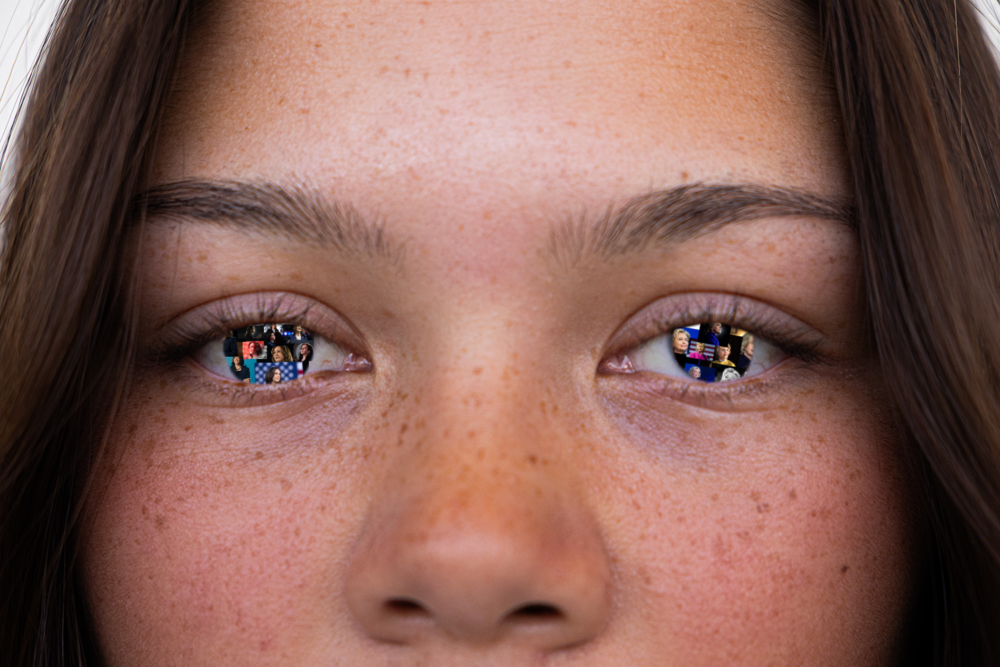
Over the past several decades, the political playing field has leveled for women (Merrefield 2024). Since 1990, the percentage of female senators and House representatives have both increased by 23% (Schaeffer 2023). However, American women continue to wonder, why has there never been a female president?
Research points repeatedly to misogyny in the American media. Numerous news outlets, political journalists, and magazines continue to uphold gendered biases that exclude women from positions of high political power. When reporting on both male and female candidates, the media is more likely to mention the gender of women than men and report negatively about women candidates (Sanbonmatsu 2015). The media reports more on family, children (or lack thereof), and appearance for female candidates (Falk 2008:55; Sanbonmatsu 2015; Van der Pas & Aaldering 2020). Journalists and interviewers use feminine stereotypes, like soft, to question their ability to lead (Andrich 2025; Falk 2008:53). Reporter and viewer bias also shapes the reception of female candidates (Merrefield 2024).
Women Rather than Candidates
Leading up to the 2024 election, in an interview with Fox News, Vice President J.D. Vance described Democrats as a “bunch of childless cat ladies.” In the same interview, he suggested that the childless Democrat politicians, especially women, lack “a direct stake in [our country]” (Licon 2024). Vance, along with other Republicans and the political media, weaponized these stigmatized stereotypes, signaling failure of traditional womanhood to prevent female competitors from attaining positions of political authority. He argued that, by not having her own children, childless women, like Kamala Harris and Alexandria Ocasio-Cortez, do not fulfill the requirements to lead the nation.
Firstly, gender is disparately acknowledged between men and women in politics (Sanbonmatsu 2015). In the American media, no journalist or reporter calls a man’s gender into question when discussing their political abilities, however women’s gender is largely overemphasized. The media thus suggests that men are inherently fit to lead our nation, diminishing female political leaders and discouraging them from seeking more political power.
The U.S. media portrays and describes male candidates in traditional masculine ways that emphasize their leadership qualities, while female candidates are undermined by coverage addressing their feminine qualities. The media specifically uses words representing masculinity, like dominant, aggressive, and strong, to portray male candidates (Falk 2008:53). In comparison, female candidates often receive more coverage about their feminine traits, such as being portrayed as passive, emotional, and soft (Andrich 2025; Falk 2008:53).
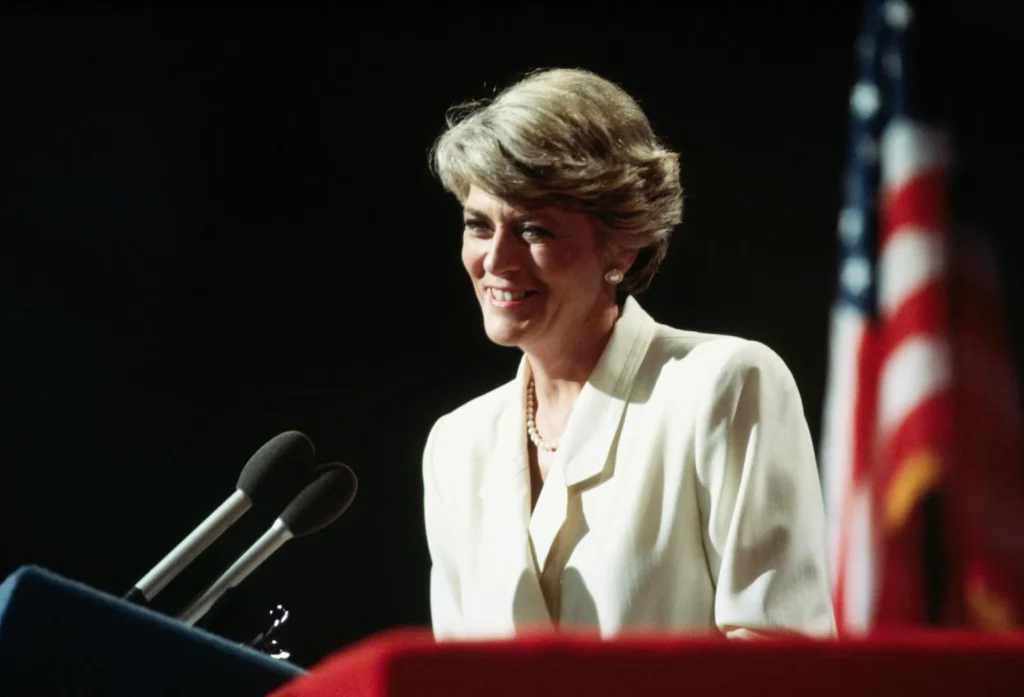
The media weaponizes gender stereotypes and cherry-picks the information it chooses to share with its viewers, portraying a female candidate as too weak or soft to negotiate with foreign leaders or keep the country secure. Geraldine Ferraro, the 1984 Democratic vice presidential candidate, for example, was asked in an interview with NBC’s Meet the Press if she was “strong enough to push the button” or if she thought the Soviets “might be tempted to take advantage of [her] simply because [she] is a woman” (Falk 2008:52).
Female candidates are stereotypically associated with more private and domestic life. The media reports more on their families, marriages, and personal background than that of male candidates (Van der Pas and Aaldering 2020). One 2002 study found that the media reported on female gubernatorial and senatorial candidates’ marital status eight times as often as male candidates’ (Sanbonmatsu 2015). The media’s scrutiny of family and marital lives of female candidates adds an extra hurdle for women that they must overcome to be perceived as a good leader.
Women politicians additionally receive significantly more coverage about their appearance and fashion choices than men (Van der Pas & Aaldering 2020). The media uses fashion and style to judge the professionalism and abilities of female politicians (Chambers 2023; Parr 2014). Margaret Thatcher’s black handbag, for example, was characterized in the media as a symbol for her “tough negotiation tactics”. In a 1985 interview, Thatcher explained that her fashion choices were “a part of the job,” emphasizing the extra standards that female politicians have to fulfill to be perceived as fit leaders (Parr 2014).
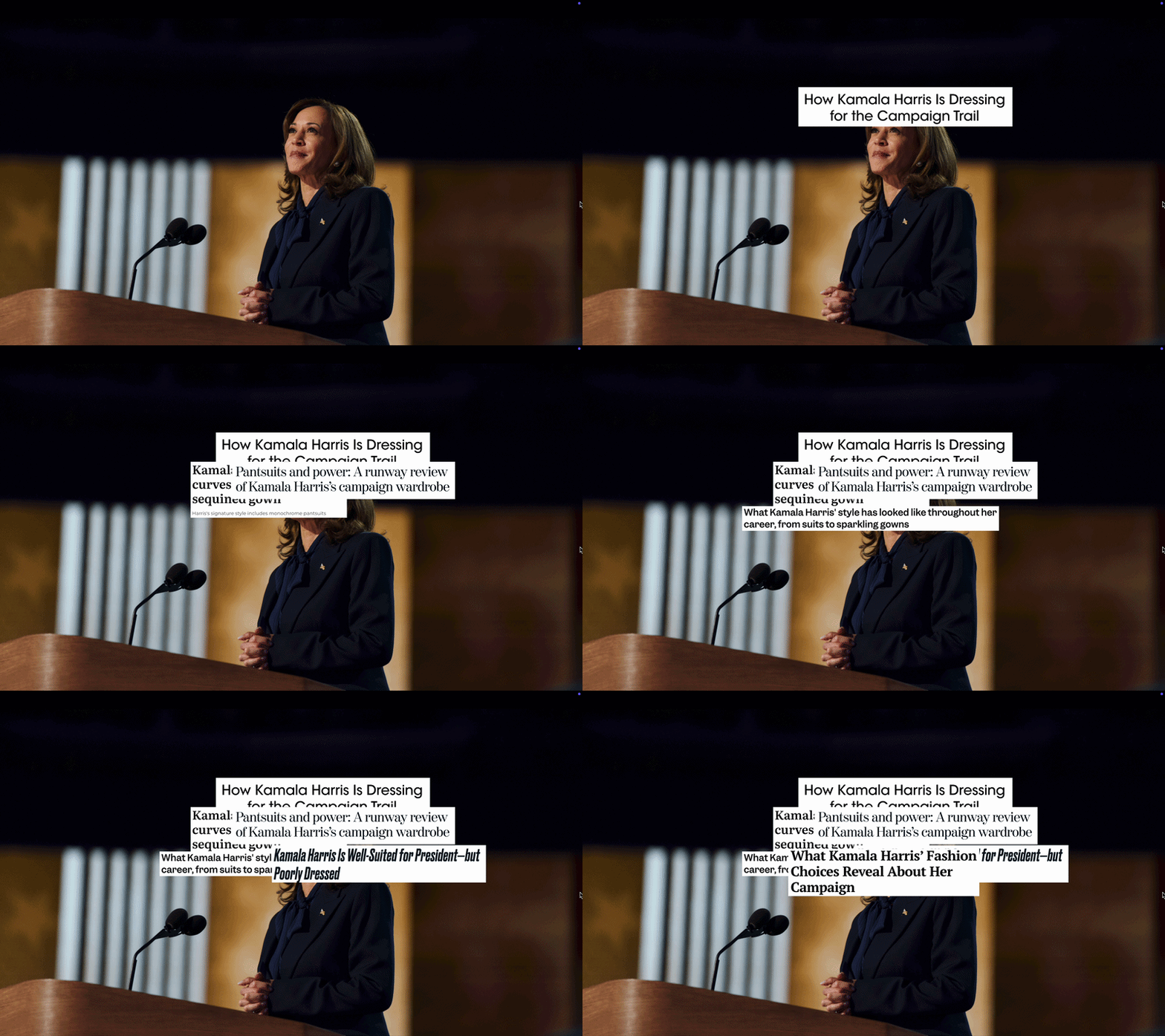
Through its coverage of fashion and style for female politicians, the media perpetuates harmful gendered expectations. It suggests that political candidates should be defined by what they wear and their worth is tied to their appearance while also confining them to traditional, decorative roles unfit for equal political authority.
Reporter and Viewer Gender Bias
The media expresses higher levels of mistrust and uncertainty in female candidates than male candidates. In the 2008 Democratic primary, Hillary Clinton, while receiving equal media coverage, received more negative coverage than Barack Obama. The media reported more on if and when she would drop out of the election than normal for presidential candidates, demonstrating evident doubt in her candidacy (Sanbonmatsu 2015).
In American news sources, female reporters are more likely than male reporters to cover the qualifications of female politicians (Merrefield 2024). The unilateral representation of female politicians by women in the media largely decreases the receptiveness of the viewers. Data scientist Adam Ozer (2023) concluded that, despite having the same credentials as male reporters, female reporters are viewed as having less expertise (Ozer 2023). Thus, the lack of trust in female reporters from viewers overall harms the credibility of female politicians.
How can women win?
Political scientists and researchers have identified various kinds of gender bias in the American media as a scrutinizing and excluding women. However, very few solutions have been proposed.
While the media spreads harmful ideas of female politicians, the viewer is also responsible. It is the viewer’s responsibility to reject biases and stereotypes and to form their own conclusions of each candidate, man or woman.
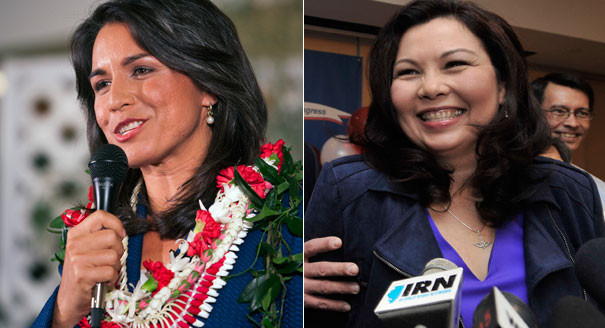
Finally, candidates can use gender stereotypes and biases in the media to their advantage. Tammy Duckworth and Tulsi Gabbard, for instance, are two female politicians who served in the U.S. military. Their military service, traditionally associated with strength and masculinity, allowed these two women to be perceived as more fit for political leadership (Grant 2025).
What does this mean for America?
American politics has long excluded women from positions of political power, undermining the very principle this country is built on—democracy. For a nation that prides itself on freedom and equal rights, America has penalized women for participating in politics and national leadership roles. Despite women’s recent political advances, they still struggle in the media and to reach the highest office in the nation.
References
Andrich, A. (2025) Beyond neutrality: A longitudinal analysis of gender, party, and media visibility in the tone of US political coverage,Sage Journals. (https://journals.sagepub.com/doi/10.1177/19401612251318187).
Chambers, C. (2023) More than a dress: An examination of America’s sexist obsession with women politicians’ wardrobes, IGNITE. (https://ignitenational.org/blog/more-than-a-dress/).
Falk, E. (2008) ‘Baking Muffins and Bombing Countries’, in Women for President: Media Bias in Eight Campaigns. Urbana, Illinois: University of Illinois Press, pp. 52–55.
Grant, T. (2025) How women with military backgrounds are changing the face of politics, Britannica. (https://www.britannica.com/topic/How-Women-with-Military-Backgrounds-Are-Changing-the-Face-of-Politics).
Licon, A.G. (2024) Clip resurfaces of Vance criticizing Harris for being ‘childless,’ testing Trump’s new running mate, AP News. (https://apnews.com/article/jd-vance-kamala-harris-childless-trump-0a37e991097b66c52bff5bf7ecf8de7b).
Merrefield, Clark. 2024. How the media cover women in politics: 5 recent studies to know, The Journalist’s Resource. (https://journalistsresource.org/media/gender-bias-news-politics/).
Ozer, Adam. 2023 Women experts and gender bias in political media, Public opinion quarterly. (https://pmc.ncbi.nlm.nih.gov/articles/PMC10408780/)
Parr, Owen. 2014. Female appearance in politics: A media obsession, Brown Political Review. (https://brownpoliticalreview.org/female-appearance-in-politics-a-media-obsession/)
Sanbonmatsu, Kira. 2015 Media coverage of women candidates, Political Parity. Available at: https://www.politicalparity.org/wp-content/uploads/2017/10/Parity-Research-Women-Media.pdf.
Schaeffer, Katherine. 2023 Data on women leaders in the U.S., Pew Research Center. Available at: https://www.pewresearch.org/social-trends/fact-sheet/the-data-on-women-leaders/.
Van der Pas, Daphne Joanna. and Aaldering, Loes. 2020. Gender differences in political media coverage: A meta-analysis | Journal of Communication | Oxford academic, Oxford Academic. Available at: https://academic.oup.com/joc/article/70/1/114/5761879.
