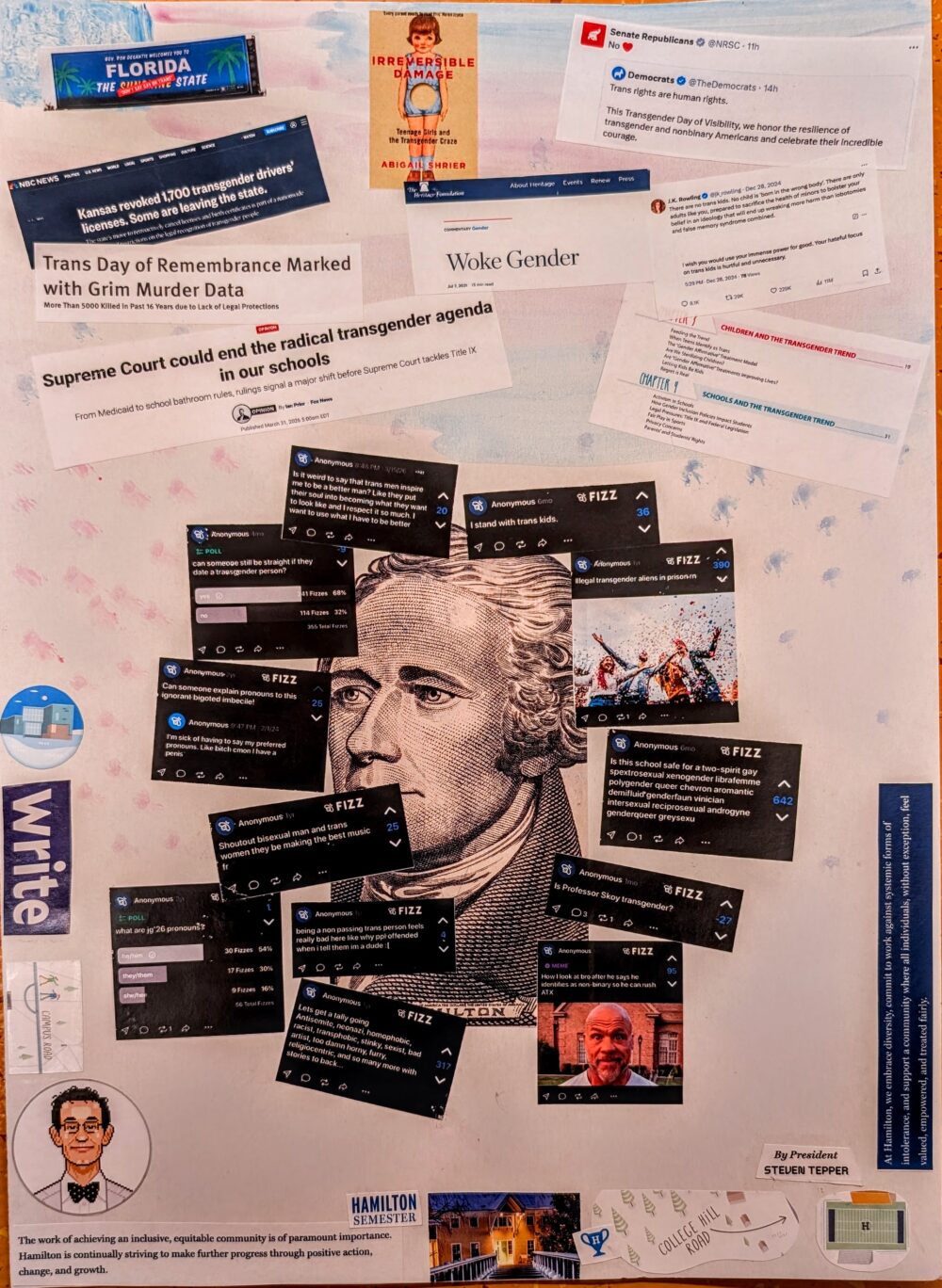
Transphobia – negative attitudes, prejudice, and discrimination towards transgender, non-binary, and gender non-conforming people – has been increasing in the United States (The Economist 2023). It is increasing in popular media, social media, local and national legislation, and in the attitudes of the general population. It is especially visible through the increase in hate crimes and violence against transgender people (HRC Foundation 2024). A prominent non-profit LGBTQ+ advocacy organization reported that in 2025, in comparison to 2023-24, there was a 14% increase in harassment, threats, vandalism, and assault against trans people in the US (GLAAD 2025).
Despite sensational media stories telling us that higher education is pushing students to have more “woke” attitudes about gender, transphobia is not absent on college campuses. In fact, as the United States general population has become more transphobic, it is possible that college students will follow suit. After all, they are still consuming mainstream and social media. To investigate whether the national shift towards popular transphobic rhetoric has influenced college students, I analyzed social media posts from the last two years at Hamilton College, the school I attend. What I found was that there has been an increase in transphobic rhetoric over the past two years.
The Rise and Effects of Anti-Trans Legislation
Trans people are facing skyrocketing legal and political threats to their day-to-day lives and existence (Trans Legislation Tracker 2026a). Anti-trans bills and laws have been rapidly increasing since 2021.
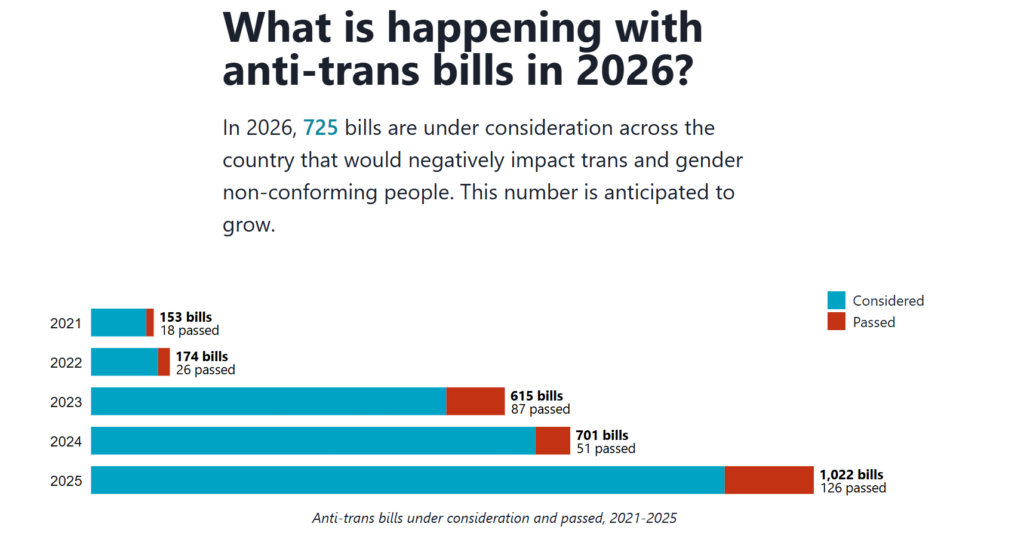
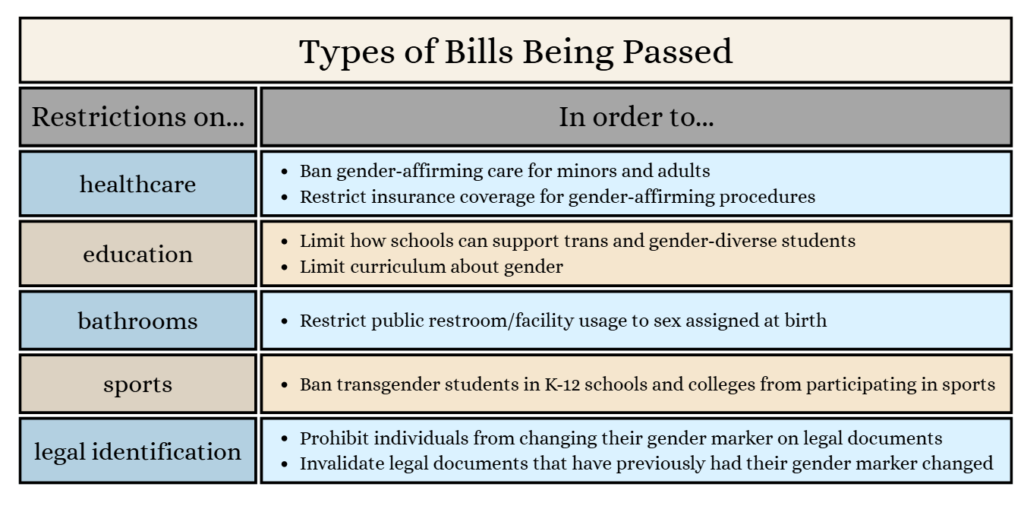
In 2025 alone, 126 anti-trans bills were passed and became law. These included restrictions on healthcare, education, bathrooms, sports, legal identification, and more (Trans Legislation Tracker 2026b).
Anti-trans legislation hurts individuals in the short and long-term through removing previous organizational support. For example, some gender-affirming medical care centers – places that offer mental health resources, counseling, hormone treatments, and surgical options for gender-diverse people – are closing or no longer seeing patients under 19, due to fear of legal backlash or loss of funding (Chinn 2025).
This rise in anti-trans legislation is correlated with an increase in anti-trans rhetoric (GLAAD 2026, McLamore and Fuller 2026). This rhetoric starts in corners of the “anti-Trans internet” (Billard 2023) and spreads to right wing media circles (Channon and Mathieson 2025). This then diffuses to the mainstream public, where it becomes normalized in mainstream attitudes.
This mainstreaming of online transphobia has contributed to the normalization of transphobic attitudes and support for anti-trans legislation. A study on transphobia found that YouTube creators and commenters framed their transphobia deliberately as a “threat-based narrative” instead of using explicit hate speech, which made it appeal to a wider audience (Channon and Mathieson 2025). This “threat-based narrative” is a common and successful tactic of anti-trans messaging, and promotes the idea that trans people and “gender ideology” are a physical danger to women and children (McLamore and Fuller 2026).
These negative factors – legal discrimination, lack of healthcare, politicization of daily life, increased risk of being a victim of a hate crime – all compound to negatively affect trans peoples’ mental health and mental ability to cope (Zwickl et al. 2025). Trans people are increasingly fearful for their safety and their futures (McCauley 2025).
Is Transphobia Increasing at Hamilton College?
How are college students, specifically here at Hamilton, affected by the general increase in popular transphobia? Historically, college students are much more liberal than the general population (Kuntz 2024). However, given that Hamilton does not exist in a bubble, it is also possible that students have been influenced by the increase in anti-trans narratives they see online and in the media.
To test this and see whether Hamilton students were absorbing transphobic messaging, I examined a sample of “Fizz” posts that include transphobia. Fizz is the popular campus social media app. Its posts are anonymous, time-stamped, and quantitatively reflect engagement. I surveyed the app using the search terms: “trans”, “transgender”, “pronouns”, “queer”, “misgender”, “non binary”, and “transition”. I documented the following for each post: when it was posted, the type (original post or repost), the full text, the number of upvotes (the result of the total upvotes and downvotes), the number of reposts and/or replies (to measure engagement), notable replies, poll results, and whether posts included language frequently used by the political right as transphobic talking points (GLAAD 2026). From these searches, I found and recorded a total of 44 posts from January 31, 2024 to February 28, 2026 that referenced transgender people, being transgender, or included language about gender as a spectrum and/or not inherently tied to sex.
My analysis reveals that there has been a 77% increase in the percentage of Fizz posts relating to trans people and gender that use or reference transphobic talking points since the 2024 election. What I have identified as transphobic talking points come from GLAAD’s Guide to Anti-LGBTQ Online Hate and Disinformation, where it lists the “most prevalent and egregious terms, tropes, and concepts that are used to harass, attack, and spread malicious misinformation” about trans people (GLAAD 2026). A few examples of the transphobic ideas that were posted on Fizz include “transvestigating” a professor, implying that men can pretend to be trans in order to rush a campus sorority, and that trans people are making up infinite genders.
This increase in transphobia on Fizz suggests that Hamilton students are seeing and absorbing the transphobic messages from the media and mainstream culture. It’s important to note that all references to transphobia are not “transphobic” posts per se, but do reference transphobic talking points. For example, two posts reference “illegal alien transgender prison operations,” but in a satiric way. These are not transphobic themselves, but instead point out the ridiculousness of someone else’s transphobia. I was unable to definitively separate posts by intention, so I will not claim that a certain percentage were sincere or satiric. However, regardless of their sincerity, the posts still normalize the language and ideas used in the media to demonize and/or put down transgender people.
These results suggest that Hamilton students are reproducing popular transphobic talking points on Fizz and (likely) in real life. By repeating transphobic talking points, whether sincerely or in a way intended to be humorous, students end up signaling to others that transphobia is normative (McLamore and Fuller 2026). Therefore, even if the transphobia is intended to be a light-hearted joke – like for instance, in a meme – just by repeating it, anti-trans attitudes are slowly built and reinforced. Those attitudes can then gradually lend support for anti-trans legislation, which then threatens the safety of transgender individuals.
Turning to the Future
If Hamilton College cares about truth, equity, and the happiness and well-being of its students, it should invest in more general programming that subtly combats the misleading transphobia that students are constantly exposed to online and in the mainstream media.
Luckily, Hamilton already has a working model of this. In my Introductory Sociology course (SOC101), we read and discussed Trans Kids, a book that documents the real lived experiences of transgender individuals and their families. From the reading and the discussion, we deepened our understanding of trans people and the transgender experience.
This opportunity was important because by reading new perspectives, asking questions, and learning about ourselves, we were able to build a base of gender literacy. That base will give us the basic tools to understand, recognize, and be skeptical of the transphobic rhetoric that is having disastrous consequences in politics today.
Sources:
Australian Human Rights Commission. 2026. “Equal Identities: A human rights review of the experiences of trans and gender diverse people in Australia.” Accessed April 1, 2026 (https://humanrights.gov.au/media/documents-files-PDFs/strategic-communications/EQUAL_IDENTITIES_FINAL_DIGITAL.pdf).
ACLU of Kansas. 2026. “Transgender Kansans Challenge State Law Invalidating Their Driver’s Licenses and Allowing Them to Be Sued for Using Public Restrooms.” ACLU. Accessed March 5, 2026 (https://www.aclu.org/press-releases/transgender-kansans-challenge-state-law-invalidating-their-drivers-licenses-and-allowing-them-to-be-sued-for-using-public-restrooms).
Beyer, Sylvia. 2020. “Relation between College Students’ Conservatism and Negative Stereotypes about Social Groups” Social Sciences 9 (12). Accessed February 24, 2026. (https://doi.org/10.3390/socsci9120224).
Billard, Thomas J. 2023. “‘Gender‑Critical’ Discourse as Disinformation: Unpacking TERF Strategies of Political Communication.” Women’s Studies in Communication 46 (2). Accessed April 1, 2026 (https://doi.org/10.1080/07491409.2023.2193545).
Channon, Lydia, and Nicola Mathieson. 2025. “Automated Detection of Mainstreamed Transphobic Content on YouTube.” Bulletin of Applied Transgender Studies 4 (1-3). Accessed April 20, 2026 (https://doi.org/10.57814/49jz-0663).
Chinn, Emma. 2025. “As Clinics Across the Country Cease Gender-Affirming Care for Youth, the Trans Youth Emergency Project is Ready With Support.” Campaign for Southern Equality. Accessed March 3, 2026 (https://southernequality.org/clinic-closures/).
GLAAD. 2025. “2025 GLAAD ALERT Desk Report.” Accessed March 3, 2026 (https://glaad.org/2025-alert-desk/).
GLAAD. 2026. “Guide to Anti-LGBTQ Online Hate and Disinformation.” Accessed April 1, 2026. (https://glaad.org/smsi/anti-lgbtq-online-hate-speech-disinformation-guide/).
Human Rights Campaign Foundation. 2024. “The Epidemic of Violence Against the Transgender & Gender-Expansive Community in the U.S.” Human Rights Campaign Reports. Accessed March 3, 2026 (https://reports.hrc.org/an-epidemic-of-violence-2024).
Kuntz, Anna. 2024. “Why do so many students on college campuses lean left?” The Pitt News. Accessed March 5, 2026 (https://pittnews.com/article/191363/top-stories/why-do-so-many-students-on-college-campuses-lean-left/).
Luneau, Delphine. 2025. “FBI’s Annual Crime Report: Hate Crimes Against LGBTQ+ Community Remain Among Top 3 Most Reported Categories.” Human Rights Campaign. Accessed March 3, 2026 (https://www.hrc.org/press-releases/fbis-annual-crime-report-hate-crimes-against-lgbtq-community-remain-among-top-3-most-reported-categories).
McCauley, Jane. 2025. “Fears rise among trans people under political persecution.” PBS Wisconsin. Accessed March 3, 2026 (https://pbswisconsin.org/news-item/fears-rise-among-trans-people-under-political-persecution/).
McLamore, Quinnehtukqut, and Kat Fuller. 2025. “Dynamics of Transphobic Content and Disinformation: Introduction to the Special Issue.” Bulletin of Applied Transgender Studies 4 (1-3). Accessed April 20, 2026 (https://doi.org/10.57814/ktm8-sh84).
Natividad, Ivan. 2021. “Why is anti-trans violence on the rise in America?” UC Berkeley News. Accessed March 5, 2026 (http:/news.berkeley.edu/2021/06/25/why-is-anti-trans-violence-on-the-rise-in-america/).
Pew Research Center. 2026. “Americans have grown more supportive of restrictions for trans people in recent years.” Accessed April 20, 2026 (https://www.pewresearch.org/short-reads/2025/02/26/americans-have-grown-more-supportive-of-restrictions-for-trans-people-in-recent-years/).
Quinan, CQ. 2025. “From criminalization to erasure: Project 2025 and anti-trans legislation in the US.” Crime, Media, Culture: An International Journal 21 (4). Accessed March 5, 2026 (https://doi.org/10.1177/17416590241312149).
The Economist. 2023. “America’s far right is increasingly protesting against LGBT people.” Accessed March 5, 2026 (https://link.gale.com/apps/doc/A733184347/AONE?u=nysl_ce_hamilton&sid=bookmark-AONE&xid=8759fb18).
Trans Legislation Tracker. 2026. “Tracking the rise of anti-trans bills in the U.S.” Accessed March 5, 2026 (https://translegislation.com/learn).
Trans Legislation Tracker. 2026. “What anti-trans bills passed in 2025?” Accessed March 5, 2026 (https://translegislation.com/bills/2025/passed).
Zwickl, Sav, Sasha Bailey, Rin Chan, Joel Murray, Foster Skewis, Stevie Lane, Julian Grace, Eli Ward-Smith, Tomi Ruggles, and Ada S Cheung. 2025. “Exposure to anti-trans rhetoric, policies, and violence: associations with mental health outcomes in Australian trans and gender diverse communities.” Research Square. Accessed February 24, 2026 (https://www.researchsquare.com/article/rs-7152164/v1).
