
This sculpture depicts a pair of hands emerging from a ruined Bible and grasping gold coins, which represent religious institutions contradicting Biblical teaching on materialism and greed.
“For what is a man profited, if he shall gain the whole world, and lose his own soul?” KJV Matthew 16:26
As a result of the ongoing right-wing influence on various Christian denominations across the United States, many congregations’ support for individualistic economic policy has increased. These Christian religious lenses’ are supporting profit-seeking behavior in various ways (Baumann 2016). As Christians, it seems like this shift directly contradicts Biblical teachings against materialism and coveting.
Christianity is rooted in supporting the benefit and care of all, not only those with a surplus of blessings. Scripture provides teachings that admonish those who place much importance on wealth (Booth 2023). In some interpretations of the Bible, the only time Jesus ever became angry was when merchants overtook a temple, and Jesus drove them out yelling, “Stop turning my Father’s house into a market!” (NIV John 2:15-16). Under contemporary capitalism, however, these values can be hard to follow, even for churches.
As a mindset of marketization has crept into the larger nonprofit sphere, churches have not been immune to its influences. Business-like managerial strategies and terminology have been adopted by mainstream churches. While capitalist norms have pushed churches to implement these business strategies, shrinking congregation size has made it a matter of survival (Moberg 2022).
Blessed or Bought?
Churches regularly compete with each other for members, with nearly half of all U.S. churchgoers attending only 9% of churches. Religious institutions have been forced into a position where they must focus on growth and profit to stay afloat. The increasing concentration of congregation members in a smaller number of churches shows some churches are better at gaining followers than others (Chaves et al. 2021). As a result, more people are exposed to the messages of these market-focused churches – the ones that get the most followers.
Market logic is also influencing some churches’ teachings. Movements like the Prosperity Gospel, the belief that wealth is a blessing from God, emphasize individual financial responsibility, similar to conservative politics (Koch 2010). Such a viewpoint naturally opposes the stance of helping and giving to others found in the Bible. It also introduces a political direction, whether purposefully or not (Baumann 2016). This position can fail to acknowledge systematic inequality (Baumann 2016). Those with a Prosperity orientation also tend to identify and vote as Republicans (Koch 2010).
Right-Wing Emphasis on Wealth
While it is not new for churches to be profit-driven, there has been increasing support for capitalist values across many Protestant denominations. Some important examples are the “Seven Sisters”. This group of mainline denominations, prominent within the U.S., have been increasingly practicing business-like strategies and emphasizing finances in their practices and messaging. This behavior has a clear effect on congregation members, with a 7% increase in agreement with the statement “God wants me to prosper financially” from 2017 to 2022 (Sullivan 2023).
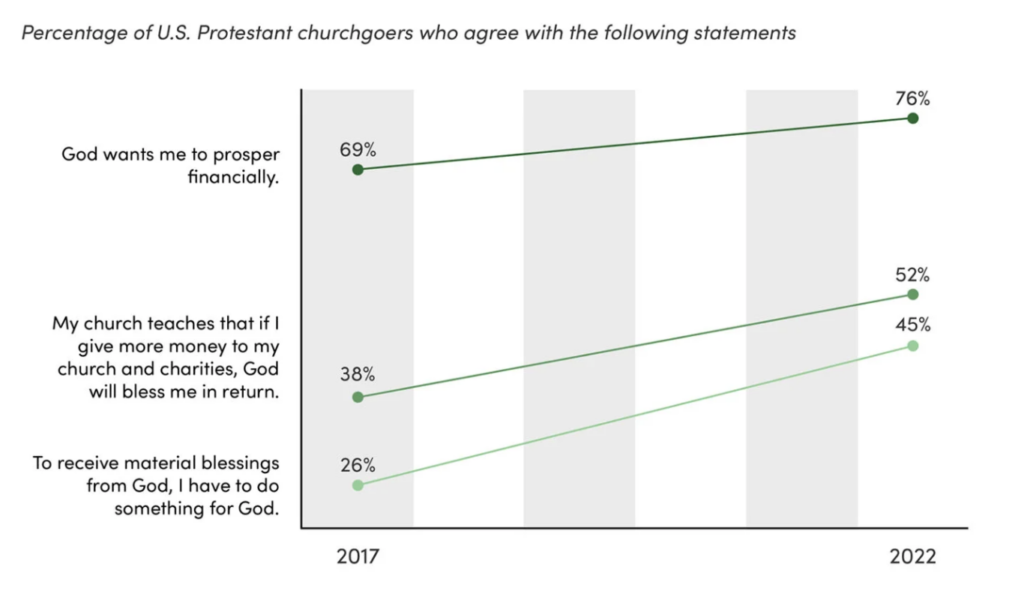
The results of a study from Lifeway Research on Protestant churchgoers who agree with these statements (Sullivan 2023).
Groups such as the Faith & Freedom Coalition and the Family Research Council have also been influential in mobilizing evangelical voters in support of conservative politicians (Rozell & Wilcox 2017). They have particularly supported economic policies centered around tax reduction, limited government intervention, and deregulation – policies that disproportionately benefit corporations and higher-income individuals (Rozell & Wilcox 2017). This is also reflected in Christian Nationalism’s effect on leading Christian Americans towards more libertarian and pro-wealthy views (Perry 2026).
Consequences for Communities
Increased conservative economic leanings and support for White Christian Nationalism within congregations exacerbate divisiveness and polarization within the U.S. as a whole (Perry 2022). Churches act as a source of community for many, and therefore have great effects on the political attitudes of members (Cremer 2021).
Whether you are a community member affected by politicized churches or not, the increasing capitalistic tendencies of churches affect everyone in our country. Churches have long been a staple of both community and volunteerism in the United States (Ternullo 2024). A mainstream shift to capitalistic norms and incentives turns against core teachings of the church and intensifies political division. It may also continue to shrink the welfare state and leave the most vulnerable on their own. As one of the major institutions that have traditionally given aid to the poor, churches’ generosity may be dampened due to their prioritization of profits instead of assistance to others. This contradicts the Biblical teachings that support and benefit the care for all.
References
Baumann, Roger. 2016. “Political Engagement Meets the Prosperity Gospel: African American Christian Zionism and Black Church Politics”, Sociology of Religion, Volume 77, Issue 4, Pages 359–385. Retrieved April 1, 2026 (https://doi.org/10.1093/socrel/srw050).
Booth, Robbie. 2023. “A Theology of Wealth from the Book of James”, Southeastern Theological Review, Volume 14, Issue 1, Pages 23-44. Retrieved April 30, 2026 (https://www.sebts.edu/wp-content/uploads/2023/03/STR-Issue-14.1.2-Booth.pdf).
Chaves, Mark, Joseph Roso, Anna Holleman, and Mary Hawkins. 2021. Congregations in 21st Century America. Durham, NC: Duke University, Department of Sociology (https://sites.duke.edu/ncsweb/files/2022/02/NCSIV_Report_Web_FINAL2.pdf).
Connolly, William E. 2010. “Capitalism and Christianity, American Style”, Contemporary Political Theory, Volume 9, Pages 131-133. Retrieved April 30, 2026 (doi:10.1057/cpt.2008.63).
Cremer, Tobias. 2021. “Nations Under God: How Church–State Relations Shape Christian Responses to Right-Wing Populism in Germany and the United States.”Religions 12(4):254 (https://www.proquest.com/scholarly-journals/nations-under-god-how-church-state-relations/docview/2530145219/se-2). doi: (https://doi.org/10.3390/rel12040254).
Koch, Bradley A. 2010. “The Prosperity Gospel and Economic Prosperity: Race, Class, Giving, and Voting.” Order No. AAI3378362 dissertation (https://www.proquest.com/dissertations-theses/prosperity-gospel-economic-race-class-giving/docview/743062723/se-2).
Moberg, Marcus. 2022. “Understanding Religious-Organizational Marketization: The Case of the United States Mainline”, Journal of the American Academy of Religion, Volume 90, Pages 815-835. Retrieved April 30, 2026 (https://doi.orh/10.1093/jaarel/lfac076).
Perry, Samuel L. 2026. “The Christianity of Capital? Christian Nationalism, Socioeconomic Status, and Divergent Views on Organized Labor”. Sociology of Religion, sraf040 (https://doi.org/10.1093/socrel/sraf040).
Rozell, Mark J. & Clyde Wilcox. 2017. God at the Grassroots 2016: The Christian Right in American Politics. Lanham, Maryland: Rowman & Littlefield.
Sullivan, Marissa P. 2023. “Prosperity Gospel Beliefs on the Rise Among Churchgoers”. Lifeway Research. Retrieved April 20, 2026 (https://research.lifeway.com/2023/08/22/prosperity-gospel-beliefs-on-the-rise-among-churchgoers/).
Ternullo, Stephanie. 2024. How the Heartland Went Red: Why Local Forces Matter in an Age of Nationalized Politics. Princeton, New Jersey: Princeton University Press.
