
Colleges with need-blind admissions policies present this approach as a great equalizer for lower-income students in higher education. Under this system, colleges and universities promise to not factor in a student’s ability to pay tuition when considering admissions, acting as if they are “blind” to a student’s need. Roughly 100 U.S. colleges and universities currently use this practice, and it is most common at highly selective private institutions. Need-blind colleges and universities typically give a generous aid package based on a student’s financial need (Kim 2010).
Despite these efforts to equalize access, wealthy students still have many advantages and continue to have higher attendance at elite private colleges and universities (Jayakumar, Mazyck, and Page 2021). How can an admissions process that appears to omit a student’s financial need still produce unequal outcomes?
Reproducing Inequalities
College admissions decisions, unfortunately, do more than evaluate individual achievement: they continue to reproduce structural inequalities. Despite how most need-blind colleges have been around for more than a decade, there has not been much shift in the distribution of wealthy students.
As recent studies show, colleges and universities with the best earnings outcomes predominantly enroll students from high-income families (Chetty et al. 2020). Despite its need-blind application process, Hamilton College, where I attend, is no exception. Hamilton has been practicing need-blind admissions since 2010. The college states on its website that “your family’s financial need will not be a factor in your admission decision.”
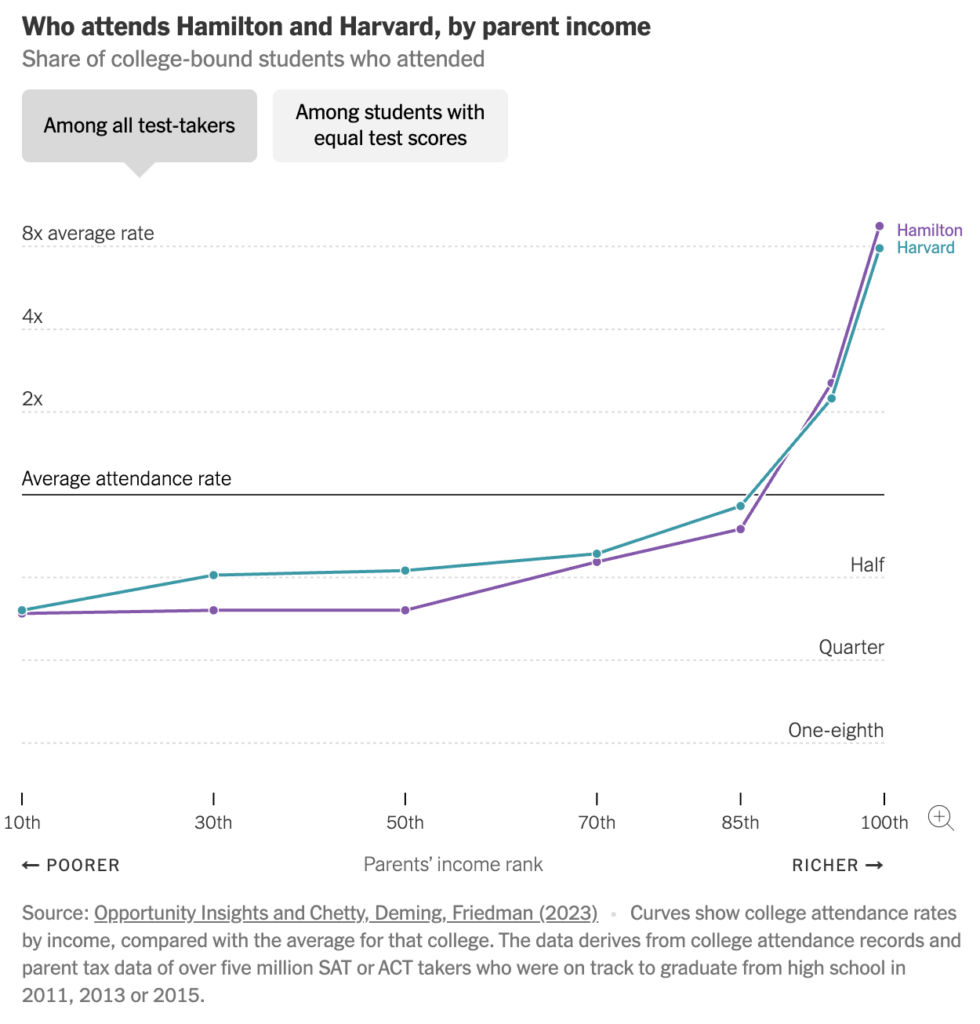
Yet, like many other need-blind colleges and universities, wealthy students and specifically those in the top 1%, are enrolled at a significantly higher rate than lower income students (Bhatia and Miller 2023). The graph below shows that the wealth distribution of Hamilton’s students is similar to Harvard’s. Compared to other institutions, Harvard has 7.5 times the average number of students from the top 1%, while Hamilton has 9.5 times the average (Bhatia and Miller 2023).
In comparison, public mid-tier colleges are more successful at enrolling students from a variety of household incomes, despite lacking need-blind admissions (Chetty et al. 2020). The colleges with the highest mobility rates, meaning they produce the best outcomes for the highest number of low income students, are colleges like the City University of New York and campuses in the Texas state university system (Chetty et al. 2020). Such comparisons raise questions about why elite schools continue to educate a greater proportion of the wealthiest Americans.
Early Decision is Not Neutral
One factor which advantages students from wealthier homes is the prevalence of early decision policies. Many need-blind elite private institutions utilize early decision application processes to allow potential students to apply and be accepted to college much earlier in the admissions cycle. While early admissions can be used by colleges to manage enrollment and gauge a students’ interest in a school, it is a binding agreement. If early admissions applicants are approved, then they are automatically committed to that college.
Because early decision is binding, this prevents students from comparing their early offer with offers from other schools. Students requiring more support are more likely to want to shop around, as a result, early decision applicants, on average, are more likely to come from higher-income families (Kim 2010).
Early decision applicants are also admitted at significantly higher rates than other applicants. Among the Ivy Leagues, the number of applicants admitted early was nearly one-half the total number of students entering a typical fall class (Kim 2010). Favoring early decision applicants privileges students from well-resourced homes.
In addition, low income students are less likely to be aware of the advantage of applying early decision. This knowledge gap is compounded by low-income students’ lack of resources and advice from college counselors in less resourced schools districts about early decision policies (Kim 2010).
Well-Rounded Applications Favor the Wealthy
Elite institutions also use a holistic review process that seeks students who are not just exceptional in academics, but succeed in sports, leadership and extracurricular activities (Jayakumar, Mazyck, and Page 2021). While this approach taken by most U.S. need-blind colleges and universities is aimed at having a more well-rounded student body, it favors students with more resources (Ornstein 2019). As Mitchell L. Stevens’ (2007) observed, holistic admissions strategies are not unique and often define merit through achievements that tend to mostly be available to upper and middle class students.
Extracurricular activities like competitive sports and music practice that require extra instruction and travel all require significant financial resources. Similarly, summer enrichment activities such as unpaid internships or foreign service that strengthen a students’ applications are not easily accessible for low-income students. Low-income students cannot fairly compete in the admissions process with others with ready access to such privileged opportunities (Jayakumar, Mazyck, and Page 2021).
Solutions
While need-blind admissions guarantee that those who apply will not be judged on their financial status, they are insufficient in reducing unequal admissions at elite schools. Lack of knowledge about the college admissions process as well as a lack of resources puts low-income students several steps behind middle and upper class students enrolling at elite institutions (Stevens 2007).
Need-blind schools should advertise this policy more effectively in low-income areas to encourage a broader range of applicants, especially as the prices for college tuition rises. Elite private institutions should also reconsider how they use early decision policies. Lastly, the holistic approach of many elite colleges and universities seeking students with distinctive and unusual accomplishments should be mindful of low income students’ many disadvantages. Without making changes, it will appear that elite colleges and universities aren’t fixing the problem with wealth inequality that they are claiming to mitigate.
References
Bhatia, Aatish, and Claire Cain Miller. 2023. “College-Access and Income Lookup.” The New York Times, September 11. Retrieved March 5, 2026.
Chetty, Raj, John N. Friedman, Emmanuel Saez, Nicholas Turner, and Danny Yagan. 2020. “Income Segregation and Intergenerational Mobility Across Colleges in the United States.” Quarterly Journal of Economics 135(3):1567–1633.
Jayakumar, Uma Mazyck, and Scott E. Page. 2021. “Cultural Capital and Opportunities for Exceptionalism: Bias in University Admissions.” Journal of Higher Education 92(7):1109–1139.
Kim, Matthew. 2010. “Early Decision and Financial Aid Competition Among Need-Blind
Colleges and Universities.” Journal of Public Economics 94(5-6):410-420.
Ornstein, Allan. 2019. “Wealth, Legacy and College Admission.” Society 56(4):335-339.
Stevens, Mitchell L. 2007. Creating a Class: College Admissions and the Education of Elites. Cambridge, MA: Harvard University Press.
