Gun violence is the leading cause of death for children under the age of nineteen in the United States (Rencken et al. 2025). In America, twenty-five percent of mass shootings happen in schools (Nassauer 2025) and continue to increase unabated (Capellan and Gomez 2018).
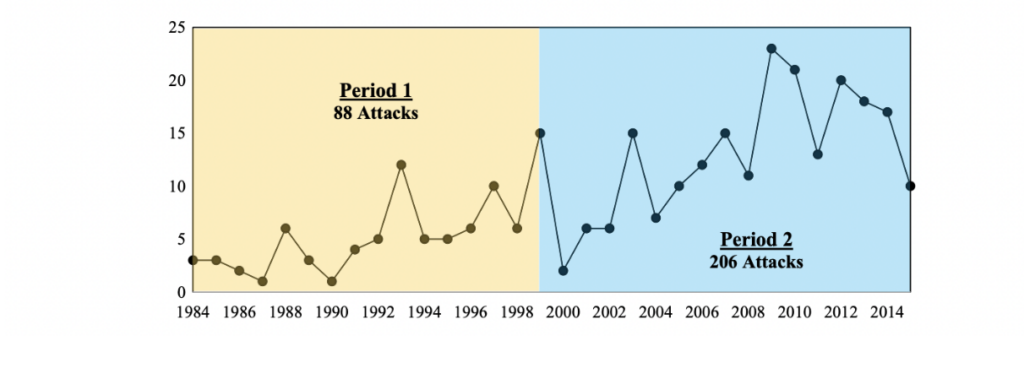
Mass public shootings in the United States from 1984 to 2015 (Capellan and Gomez 2018).
There have been twice as many mass shootings in the first 16 years of the 21st century than the last 16 years of the 20th century (Capellan and Gomez 2018). As gun violence increases in the United States, it is essential to investigate this issue and its causes. Scholars suggest that the perceived unattainable, masculine standards for some men, in addition to gun culture, lead some young white men to become school shooters (Newman 2004).
Masculine Bullying & Shooters
Many school shooters experience high levels of bullying. They are often harassed and victimized, leading them to feel excluded or rejected by society (Raitanen et al. 2019). Specifically, one of the main forms of bullying in schools that can predict school shootings is the targeting of boys, viewed by their peers as not masculine enough.
Social norms often portray masculinity as a dominant trait, tied to a sense of having control and being in charge (Maynen 2013). When some boys are perceived as failing to attain this standard and bullied for it, they may feel not masculine enough to be socially accepted. Over time, if they become increasingly isolated and cast outside peer social circles, they lack the connections and support that help maintain their mental health and sense of identity (Newman 2004).

A school shooter viewing the unattainable standards of American masculinity, while people taunt him.
School shooters are more likely to suffer from mental disorders, including depression and anxiety (Capellan and Gomez 2018). They may feel like taking control through a school shooting would proves that they are masculine and is the only option to gaining social power and integration (Maynen 2013). Although girls struggle with their own psychological problems, they are more likely to stay connected to others, making them less likely to become school shooters (Newman 2004).
Gun Culture
The U.S. has the highest number of firearms per capita in the world and has a uniquely strong cultural association of guns with personal and national identity (Nassauer 2025). Many children who become mass shooters grow up in a community that values and normalizes guns. They have easy access to these weapons and view them as essential to their social and family lives (Nassauer 2025). Specifically in rural areas, the percentage of gun owners is high, with 72% of rural Americans growing up in a gun household (Nassauer 2025). School shootings are much more likely to happen in these rural areas because of the strong association and presence of guns (Maher at al 2022).
Taken together, the local and national culture that normalizes and connects guns with social esteem puts a social outcast at great risk of believing gun violence will lead to social power. Picking up a gun offers an easy way for aggrieved young white men to take control and get revenge, showing that they can be “masculine” enough to fit into their community.
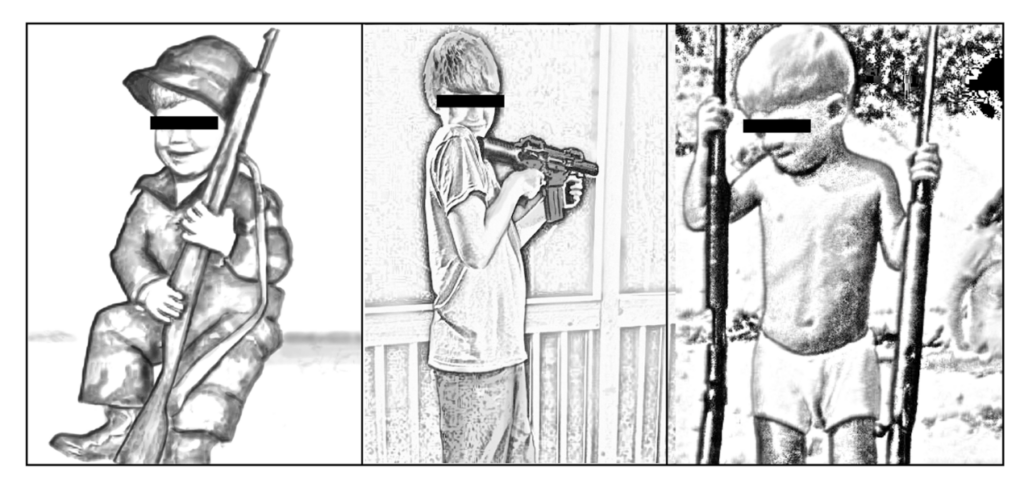
Three school shooters as children (Nassauer 2025).
Possible Solutions
One way to stop this cycle is to recognize and raise awareness about the damage social exclusion has on people, especially children. When at-risk boys express violence or threats, they are often ignored or not acknowledged. Specifically in rural areas, the smaller community and personal ties give teachers a false sense of security that if something bad were to happen, they would know about it and prevent it, causing them to underestimate some threats (Fox et al 2005).
In addition, the organizational pressures of the school district cause teachers to focus mainly on educational attainment, restricting the amount of time teachers spend helping students combat social challenges, such as bullying. If a potential shooter’s behavior does not disrupt everyday school functioning, it often goes unnoticed (Fox et al 2005).
Shooters are not exposed to other kinds of masculinity that might be more attainable, or have the resources to seek alternatives to fitting in (Newman 2004). Providing resources, support, and giving attention to the kids who are struggling to fit in and being bullied, has proven to reduce school shootings (Newman 2004).
After the Columbine High School shooting in 1999, many states have adopted anti-bullying laws. As of 2017, all 50 states and D.C. have adopted a law against bullying in schools (Nikolaou 2017). When states not only adopted these laws but mandated them and required detailed plans of action, bullying and school shootings were reduced (Sabia and Bass 2017).
Anti-bullying campaigns aren’t the only solution. Between 2002 and 2015, the number unlocked and loaded guns has increased exponentially from 1.6 million to 4.6 million. Safely storing these guns decreases the risk of firearm deaths among children. Increasing the barriers to gun access through harsher gun legislation has also proven to decrease the ability for shooters to obtain their guns legally (Nassauer 2025).
When guns are so easy to get in America, it is extremely important to recognize the implications of social exclusion as well as combat the idea of gun violence as a solution. Every hour of every day, a child is shot in the United States. In the 2010s, more than 30,000 kids were killed by guns (Nassauer 2025). Being aware of school shootings’ causes, such as bullying and gun access, can help others prevent more of these events. Each step taken toward reducing school shootings is another life saved.
References:
Capellan, Joel A., and SimonPeter Gomez. 2018. “Change and Stability in Offender, Behaviours, and Incident-Level Characteristics of Mass Public Shootings in the United States, 1984-2015.” Journal of Investigative Psychology and Offender Profiling (Online) 15(1):51-72. doi: https://doi.org/10.1002/jip.149
Fox, Cybelle, and David J. Harding. 2005. “School Shootings as Organizational Deviance: A Magazine of Theory and Practice.” Sociology of Education78(1):69-97 (https://www.proquest.com/scholarly-journals/school-shootings-as-organizational-deviance/docview/216500990/se-2).
Maher, Erin J., Julie Gerlinger, Alexandra D. Wood and Katherine Ho. 2022. “Won’t You be My Neighbor? Neighborhood Characteristics Associated with Mass Shootings in the USA.” Race and Social Problems 14(3):223-237
Maynen, Dawn. 2013. “Jessie Klein: The Bully Society: School Shootings and the Crisis of Bullying in America’s Schools: The New York University Press, New York, NY, 2012, 307 Pp, ISBN: 978-0-8147-48886.” Journal of Youth and Adolescence 42(10):1630-1632 (https://www.proquest.com/scholarly-journals/jessie-klein-bully-society-school-shootings/docview/1433065406/se-2). doi: https://doi.org/10.1007/s10964-013-0001-y.
Nassauer, Anne. 2025. ““The Only Friend I had was My Gun”: A Mixed-Methods Study of Gun Culture in School Shootings.” PLoS One 20(4) (https://www.proquest.com/scholarly-journals/only-friend-i-had-was-my-gun-mixed-methods-study/docview/3194129541/se-2). doi: https://doi.org/10.1371/journal.pone.0322195.
Newman, Katherine S. 2004. Rampage: The Social Roots of School Shootings. New York: Basic Books.
Nikolaou, D. 2017. Do anti-bullying policies deter in-school bullying victimization? [Advance online publication] International Review of Law and Economics, 50. https://doi.org/10.1016/j.irle.2017.03.
Raitanen, Jenni, Sveinung Sandberg and Atte Oksanen. 2019. “The Bullying-School Shooting Nexus: Bridging Master Narratives of Mass Violence with Personal Narratives of Social Exclusion.” Deviant Behavior 40(1):96-109. (https://www.proquest.com/scholarly-journals/bullying-school-shooting-nexus-bridging-master/docview/2176608752/se-2). doi: https://doi.org/10.1080/01639625.2017.1411044.
Rencken, Conrick, Rhew, Davis, and Rowhani-Rahbar. 2025. “Survivor Perspectives on Research Priorities for Assessing Mental Health Outcomes After School Shootings: A Qualitative Study.”2025. Injury Epidemiology12(1):15 (https://www.proquest.com/scholarly-journals/survivor-perspectives-on-research-priorities/docview/3176463061/se-2). doi: https://doi.org/10.1186/s40621-025-00570-4. Sabia, Joseph J., and Brittany Bass. 2017. “Do Anti-Bullying Laws Work? New Evidence on School Safety and Youth Violence.” Journal of Population Economics 30(2):473-502 (https://www.proquest.com/scholarly-journals/do-anti-bullying-laws-work-new-evidence-on-school/docview/1865253330/se-2). doi: https://doi.org/10.1007/s00148-016-0622-z.
