Like a growing number of American families, many weekends of my childhood were consumed by my brother’s soccer tournaments and games. Some weekends were close to home, but others could be a flight away. His practices were also demanding; my brother would often get home at 9 p.m., leaving very little time to eat dinner and do homework.
My brother’s experience was a far cry from more traditional community-based leagues. Our local youth soccer league had games in easily accessible places. It was a way to keep kids physically active, and for families to enjoy the nice weather together. In those leagues, the focus was on bonding with teammates and having fun, rather than playing with top competitors.
Youth sports are shown to have myriad benefits for its participants. Studies have shown positive correlations between youth sports and improvements in academic achievement and early social development, as well as increased physical, physiological, and mental health (Merkel 2013; Ullrich-French, McDonough and Smith 2012).
Ultimately, the rise of privatized youth sports leagues have exacerbated socio-economic inequalities and access to these healthy benefits of sports, while heightening pressures surrounding the youth athletes who can actually participate (Bjork & Hoynes 2025; Knoester & Bork 2025)
Growing Exclusion with the Rise of Privatized Sports
Since the late 19th century, youth sports leagues have been a foundational part of American communities across the country (Harmon 2025). Until the 1980s, many youth sports programs were publicly funded and neighborhood-based (Coakley 2006).
During the 1980s, however, due in part to the rise of neoliberalism, youth sports became more privatized, exclusive, and profit-driven (Knoester & Bjork 2025). In 1997, Disney opened its Wide World of Sports Complex, creating the first commercialized complex for “elite” youth sports (ESPN Wide World of Sports 2026). This trend bled into the 2000s, with privatized leagues increasing pressures on young athletes to specialize in a singular sport (Knoester & Bjork 2025, Baker et al. 2009). In 2020, however, youth sports participation dipped significantly due to the COVID-19 pandemic (Johnson, Knell, Walker, Kroshus 2023). This phenomenon had a higher impact on middle and lower class families who did not have access to the vast resources of privatized sports leagues (Dorsch and Blazo 2021)
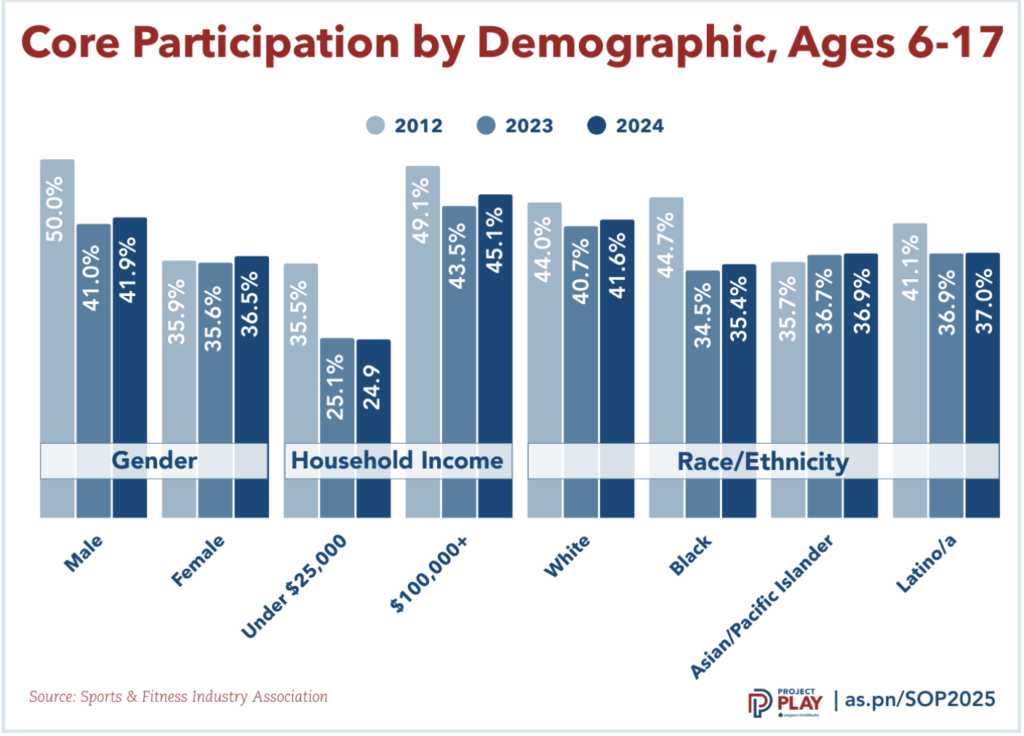
In 2012, nearly half of young people (49%) in households making $100,000 or more played a sport, while more than a third (35%) from households making $25,000 or less participated (Aspen Institute 2025). In the span of 12 years, families hovering around the poverty line had participation rates fall by 10%, while those families making 4 times the poverty line had their participation fall by only 4%. By 2024, families spent an average of $1,016 on their child’s primary sport – a 46% increase since 2019 (Dorsch and Blazo 2024). Not surprisingly, the rising costs of youth sports have continued to restrict access to families with middle and lower-class incomes. In households making $100,000 or more per year, 45% of kids and youth played sports in 2024. Only 25% of kids and youth in households making $25,000 participated (Aspen Institute 2025). This disparity in participation levels is expanding.
Youth Sports’ Limited Future
If privatized leagues cost so much money, why do families not just compete on public school sports teams? Unfortunately, that opportunity is not always available. There are considerable inequalities between schools’ athletic budgets and sports facilities in the United States. Some public schools, like The Bronx High School of Science in New York City, have their own endowed fund to fund sports (The Bronx High School of Science 2026). Most public schools lack such resources. Oftentimes, organized sports programs are the first to fall when budget cuts are enacted, leaving the kids with no options (Eyler, Valko, Serrano 2018).
A lack of school-organized sports programs can have harmful effects on kids unable to join private clubs and travel teams. There are positive relationships between sports participation and better social skills, fewer depressive symptoms, and higher confidence (Eime et al. 2013). Sports participation also has benefits that extend beyond high school. Participation in youth sports can be used to predict physical activity in adulthood, leading to better physical and mental health in older adulthood (Dohle & Wansink 2013; Jewett et al. 2014)
Specialization and Mental Health Impact
As a result of the privatization of youth sports in the 1980s, pressures to specialize in one sport to maximize future potential have also begun to take root within youth sports. In theory, specialization can have helpful benefits. Early specialization can improve an athlete’s chance to play on travel or high school varsity teams, and potentially go on to play at the collegiate level (Knoester & Bjork 2025). Early specialization is not a guaranteed method to get playing time, however. The high-volume training that it demands can lead to overuse injuries and mental burnout (Hernandez et al. 2020).
Specialization can also lead to psychosocial consequences such as decreased sport enjoyment and more disappointment and discouragement (Baker et al. 2009:79). In many early specialization contexts, children feel excessive pressure to win, have a poor perception of their ability, and feel vulnerable when around their teammates. These experiences can lead to low self-confidence and low self-esteem (Wankel & Mummery 1990).
The Need to Preserve Community Sports
At this point, privatization has been institutionalized within youth sports. Despite the many drawbacks of private club and travel leagues, there has been increasing demand for access to such leagues (Knoester & Bjork 2025). Especially in large metropolitan areas where access to facilities are limited, club sports are outcompeting and ultimately displacing local teams (Knoester & Bjork 2025).
There are some things that can be done to help improve access to sports. Rural and suburban communities are far less afflicted by lack of open space (Wallace 2021). While some communities might lack the necessary structure within the local community, implementation of a grassroots program coordination network among local parents and town officials can set up local leagues, establishing easy-access (Ostermeier et al. 2024). In larger metropolitan areas, such program coordination exists within the city’s Department of Parks and Recreation. Using NYC as an example, volunteer-run organizations such as the City Parks foundation, ShapeUp NYC, and the New York Road Runners all provide free opportunities for kids to get involved with various sports and fitness programs (NYC Department of Parks and Recreation 2026).
The greatest thing about youth sports is not the successful athletes it can produce, but the community it produces. Youth sports should be a place where skill level, economic background, and what type of insurance you have, are irrelevant. From my own experiences in youth sports, I learned how to be a gracious loser, how to persevere through things when they got hard, and how to work cohesively in a team setting. By turning youth sports into a private industry and forcing kids to specialize in a single sport, the joy and wonder of youth sports risks being destroyed. Ultimately, the goal of youth sports isn’t to find the next LeBron James. The goal is to allow the kid that might become the next LeBron James the opportunity to play.
Bibliography
Aspen Institute. 2023. “Youth Sports Facts: Challenges”. Aspen Institute. Retrieved March 2, 2026 (https://projectplay.org/youth-sports/facts/challenges).
Aspen Institute. 2025. “State of Play 2025: Participation Trends”. Aspen Institute. Retrieved April 26, 2026 (https://projectplay.org/state-of-play-2025/participation-trends#5)
Baker, Joseph, Stephen Cobley, Jessica Fraser-Thomas. 2009. “What Do We Know About Early Sport Specialization? Not Much!”. High Ability Studies 20(1):77-89. Retrieved May 4, 2026 (https://research.ebsco.com/c/gqqw7k/viewer/pdf/qycm2l5ug5?route=details)
Blazo, Jordan A. and Dorsch, Travis E. 2021. “Project Play COVID-19 Parenting Survey September, 2020”. Aspen Institute. Retrieved April 25, 2026 (https://static1.squarespace.com/static/595ea7d6e58c62dce01d1625/t/5fa984fb066f8a0264beb4f2/1604945148149/COVID-19+Parenting+Survey+FINAL+REPORT.pdf)
Blazo, Jordan A. and Dorsch, Travis E. 2024. “Project Play 2024 Parenting Survery FINAL REPORT”. Aspen Institute. Retrieved March 5, 2026
Bjork Chris and William Hoynes. 2025. “More Than Just a Game: How The Youth Sports Industry is Changing The Way We Parent and What To Do About It”. Las Vegas, NV: Central Recovery Press
Coakley, Jay. 2005. “The Good Father: Parental Expectations and Youth Sports”. Leisure Studies 25(2):153-163. Retrieved May 4, 2026 (https://www.tandfonline.com/doi/full/10.1080/02614360500467735?scroll=top&needAccess=true)
Dohle, Simone and Brian Wansink. 2013. “Fit in 50 years: Participation in High School Sports Best Predicts One’s Physical Activity After Age 70”. BMC Public Health. Retrieved May 4, 2026 (https://pmc.ncbi.nlm.nih.gov/articles/PMC3909353/)
Eime, Rochelle M., Janet A. Young, Jack T. Harvey, Melanie J. Charity, Warren R. Payne. 2013. “A systematic review of the psychological and social benefits of participation in sport for children and adolescents: informing development of a conceptual model of health through sport”. International Journal of Behavioral Nutrition and Physical Activity 10(98). Retrieved May 4, 2026 (http://www.ijbnpa.org/content/10/1/98)
ESPN Wide World of Sports. 2026. “Venues & Facilities”. Retrieved May 4, 2026 (https://www.espnwwos.com/complex/venues/)
Eyler, Amy A., Cheryl Valko, Natalicio Serrano. 2018. “Perspectives on High School “Pay to Play” Sports Fees Policies: A Qualitative Study”. Translational Journal of the ACSM 3(19). Retrieved April 25, 2026 (https://journals.lww.com/acsm-tj/fulltext/2018/10010/perspectives_on_high_school__pay_to_play__sports.1.aspx)
Harmon, Angela. 2024. “Youth Athletics”. EBSCO. Retrieved April 2, 2026 (https://www.ebsco.com/research-starters/sports-and-leisure/youth-athletics).
Hernandez, Mayrena. I, Kevin M. Biese, Dan A. Schaefer, Eric G. Post, David R. Bell, M. Allison Brooks. 2020. “Different Perceptions of Parents and Children on Factors Influencing Sport Specialization”. Journal of Sport Rehabiliation 30(2):190-197. Retrieved May 4, 2026 (https://journals.humankinetics.com/view/journals/jsr/30/2/article-p190.xml)
Jefferson Cup. 2026. “Jeff Cup Fast Facts”. Retrieved April 2, 2026 (https://jeffersoncup.rutournaments.com/jeff-cup-fast-facts/
Jewett, Rachel, Catherine M. Sabiston, Jennifer Brunet, Erin K. O’Loughlin, Tanya Scarapicchia, Jennifer O’Loughlin. 2014. “School Sport Participation During Adolescence and Mental Health in Early Adulthood”. Journal of Adolescent Health 55(5):640-644. Retrieved May 4, 2026 (https://www.sciencedirect.com/science/article/pii/S1054139X14001967?via%3Dihub)
Johnson, Ashleigh M., Gregory Knell, Timothy J. Walker, Emily Kroshus. “Differences in American Adolescent Sports Participation During the COVID-19 Pandemic by Learning Mode: A National Survey”. Preventative Medicine Reports. Retrieved April 26, 2026 (https://pmc.ncbi.nlm.nih.gov/articles/PMC9933460/)
Knoester, Chris and Chris Bjork. 2025. “The Rise of Private Club and Travel Teams in the U.S.: Generational Changes in Youth Sports Participation and Associations with Socioeconomic Statuses and Family and Community Sport Cultures”. Journal of Sport and Social Issues 49(6):487-519. Accessed May 4, 2026 (https://journals.sagepub.com/doi/10.1177/01937235251377472#bibr2-01937235251377472)
Merkel, Donna L. 2013. “Youth Sport: Positive and Negative Effects on Young Athletes”. Open Access Journal for Sports Medicine 4, 151-160. Accessed April 1, 2026 (https://pmc.ncbi.nlm.nih.gov/articles/PMC3871410/#abstract1).
New York City Department of Parks and Recreation. 2026. “Volunteer Groups”. NYC Department of Parks and Recreation. Retrieved May 5, 2026 (https://www.nycgovparks.org/opportunities/volunteer/groups/fitness#map)
Ostermeier, Emma, Jason Gilliland, Jennifer D. Irwin, Jamie A. Seabrook, Patricia Tucker. 2024. “Developing community-based physical activity interventions and recreational programming for children in rural and smaller urban centres: a qualitative exploration of service provider and parent experiences”. BMC health services research 24(1). Retrieved May 5, 2026 (https://pmc.ncbi.nlm.nih.gov/articles/PMC11373125/#Abs1)
Ulrich-French, Sarah, Meghan H. McDonough and Alan L. Smith. 2012. “Social connection and psychological outcomes in a physical activity-based youth development setting”. Research Quarterly for Exercise and Sport 83(3). Retrieved April 2, 2026 (https://pubmed.ncbi.nlm.nih.gov/22978193/)
Wankel, Leonard M. and Kerry Mummery. 1990. “The psychological and social benefits of sport and physical activity”. Journal of Leisure Research 22(2):167-182. Retrieved May 4, 2026 (https://www.researchgate.net/publication/232606496_The_Psychological_and_Social_Benefits_of_Sport_and_Physical_Activity)
Wallace, Lacey N. 2021. “Active Places: The Role of Urbanicity in Youth Exercise, Sports Participation, and Perceived Barriers to These Activities”. Journal of Sport Behavior 44(4). Retrieved May 5, 2026 (https://go.gale.com/ps/i.do?id=GALE%7CA696135360&sid=googleScholar&v=2.1&it=r&linkaccess=abs&issn=01627341&sw=w&u=nysl_oweb&p=AONE&isGeoAuthType=true&aty=geo)
West Side Soccer League. 2026. “Core Program”. Retrieved April 2, 2026 (https://www.wssl.org/programs/core/)
