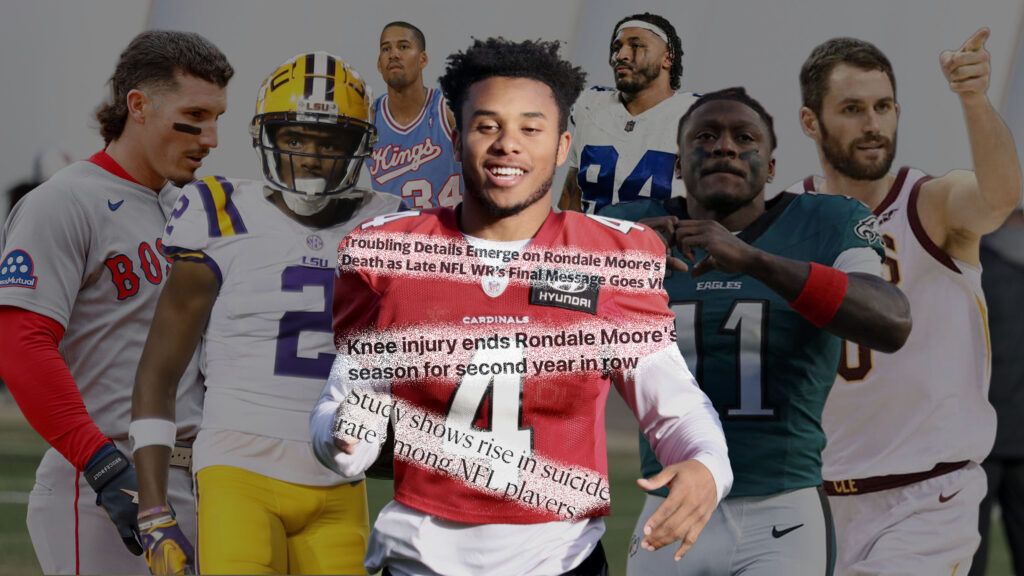
The 2026 suicide of NFL receiver Rondale Moore was a wake-up call about the mental health of professional football players (Baird 2026).
Given his fame and incredible performance on the field, Moore’s story highlights that even the most accomplished football players are struggling with mental health in the NFL (Baird 2026; Grashow et al. 2026).
Sociological studies suggest that players’ depression and anxiety are often rooted in professional football’s structures and norms (Bennett 2020; DeFreese et al. 2022; McGraw et al. 2018). These struggles represent more than individual challenges or shortcomings; they reflect the failures of the sport, the league, and its support systems.
The “Toughness” Trap
“Mental toughness” is the gold standard in football. As sport psychologist N. James Bauman (2016) explains, the sports world often treats “mental toughness” and “mental health” as opposites and contradictory. This false claim often leads to a harmful “trap” in which athletes feel they must choose between being a competitor and being a human being. As this mindset is normalized among coaches and players, it prioritizes performance over people.
Scholars have emphasized how this is associated with toxic masculinity, which pressures players not to express mental health problems. Those struggling are told to “grind through it.” Athletes learn that any sign of vulnerability is a sign of weakness and could influence their ability to play (Bennett 2020).
Compounding Systems: Beyond the Individual
Although athletes may appear to have it all, many professionals find that sports are an unstable “job” that dictates athletes’ entire lives beyond their athletic accomplishments. Factors like scholarship dependence and identity foreclosure – when athletes lack a sense of self outside of sport – contribute to a mental health crisis among student and professional athletes (Reardon 2023; Brewer and Petitpas 2017). Interviews with players and family members document that even positive aspects of the NFL pair with reports of depression, loneliness, and stress, often linked to performance pressure and anxiety about job security (McGraw et al. 2018). The struggles of professional players like Moore result from this “hidden scaffolding,” compounded with the media’s expectations and the financial stakes. Without support, these systems and pressures can overcome players, even when they have reached the pinnacle of their sport.
Athletes from lower socioeconomic backgrounds or minority groups also often face a double burden. They report higher stress levels when they have fewer resources or providers who understand their experiences (Oettle and Greiner 2021). Black athletes, in particular, often face unique barriers, such as stereotyping and a lack of culturally competent care (Wilkerson et al. 2020). Black players, from lower socioeconomic backgrounds, face added pressure to provide for their families and communities. Yet, when Black players need mental health support, they find many facilities, providers, and programs have white-dominated norms. When such treatment ignores structural racism and pressure, it creates an added burden on the individual in a broken system (Bennett 2020).
Shifting the Scoreboard for Leagues and Coaches
Fortunately, the tide is turning. Courageous athletes are starting to speak out, shifting the norms of sports culture from silence to advocacy, and slowly dismantling stigmas and removing barriers that isolate athletes (Reardon 2023).
With professional football’s culture of risk, hypermasculinity, and inequity, organizational changes and a shift to collective responsibility are needed (Bennett 2020). The NFL’s Comprehensive Mental Health and Wellness Committee has established programs like “Total Wellness,” which include routine mental health screenings, a step in the right direction (Clay 2017; Weir 2017).
When looking at the scoreboard, the focus should not be solely on wins or losses. Who gets to play, who gets to heal, and who is left behind are also part of football’s impact. It is time to stop asking athletes to “be stronger” and to start forcing institutions to be better. We can redefine our heroes as people who train not just physically but also condition their minds to be well mentally.
References
Baird, Nathan (2026, February 23). Cause of death for former Trinity football star Rondale Moore released. The Courier Journal.
Bauman N. J. (2016). The stigma of mental health in athletes: are mental toughness and mental health seen as contradictory in elite sport?. British journal of sports medicine, 50(3), 135–136.
Bennett, Michael (2020). Behind the mask: Demedicalising race and mental health in professional football. BJPsych Advances, 27(5), 305–313.
Brewer, Britton W., & Petitpas, Albert J. (2017). Athletic identity foreclosure. Current Opinion in Psychology, 16, 118–122.
Clay, Rebecca A. (2017, January). A new NFL playbook: Enhancing mental health. Monitor on Psychology, 48(1), 22.
DeFreese, J.D.; Walton, Samuel R.; Kerr, Zachary Yukio; Brett, Benjamin L.; Chandran, Avinash; Mannix, Rebekah; Campbell, Hope; Echemendia, Ruben J.; McCrea, Michael A.; Meehan, William P. & Guskiewicz, Kevin. M. (2022). Transition-Related Psychosocial Factors and Mental Health Outcomes in Former National Football League Players: An NFL-LONG Study. Journal of sport & exercise psychology, 44(3), 169–176.
Grashow, Rachel; Konstantinides, Niki; Anderson, Benjamin. C.; Leung, Michael; Fung, Eric N.; Baggish, Aaron L.: Daneshvar, Daniel H.: Grove, Wayne; Zafonte, Ross & Weisskopf, Marc G. (2026). Participation in professional American-style football and suicide mortality: 1979–2019. Journal of Neurotrauma. Advance online publication.
McGraw, Sarah: Taylor, Lauren; Cohen, I. Glenn & Deubert, Christopher (2018). Life on an emotional roller coaster: NFL players and their family members’ perspectives on player mental health. Football Players’ Health Study at Harvard University.
Reardon, Claudia L. (2023). The mental health crisis in sports: The perfect storm of contemporary factors. Journal of Athletic Training, 58(9),
Oettle, Lukas, & Greiner, Jörg (2021). Coping with poverty and social exclusion: Promoting capabilities through long-term sports participation. Sport in Society, 24(8), 1357–1373.
Weisskopf, Marc G.; Taylor, Herman A.; Connor, Ann; Baker, Jillian; Cohan, Sarah; Valdivia, Chelsea; Courtney, Theodore K; Cohen, I. Glenn; Speizer, Frank E., & Nadler, Lee M. (2019). The Football Players’ Health Study at Harvard University: Design and objectives. American Journal of Industrial Medicine, 62(8), 643–654.
Weir, Kristen (2017). A new NFL playbook: Enhancing mental health. Monitor on Psychology, 48(1). American Psychological Association.
Wilkerson, Todd A., Stokowski, Sarah, Fridley, Alison, Dittmore, Stephen W., & Bell, Charles A. (2020). Black football student-athletes’ perceived barriers to seeking mental health services. Journal of Issues in Intercollegiate Athletics, 13, 55–81
