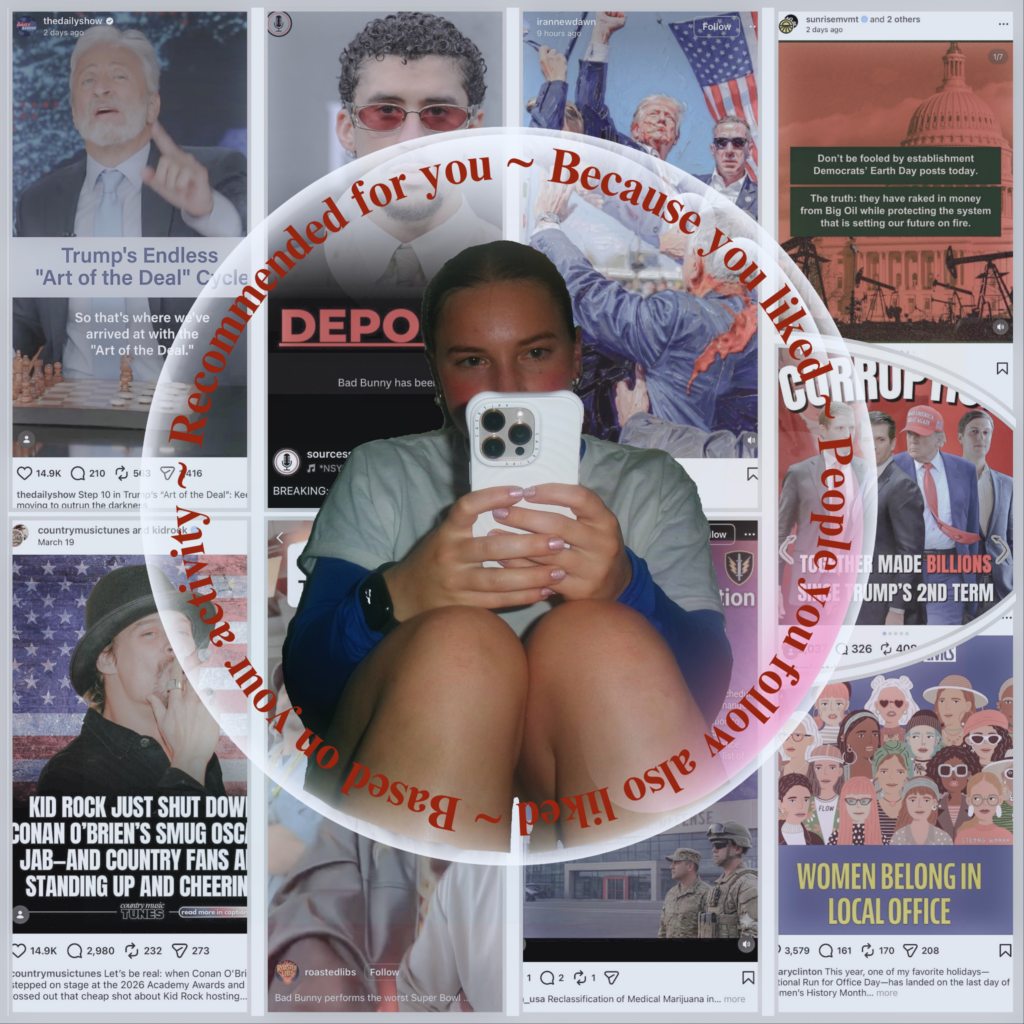
Algorithm-driven social media platforms shape perception by enclosing users in personalized content bubbles, where engagement-based recommendations reinforce and amplify exposure to increasingly polarizing information.
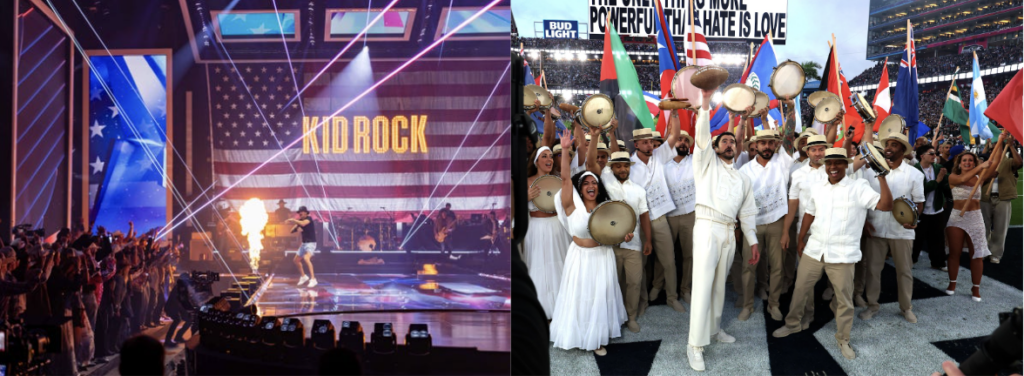
The morning after the 2026 Super Bowl, the first post on my Instagram feed was a billboard at Bad Bunny’s halftime show performance, captioned “The only thing more powerful than hate is love”. The next: Kid Rock on a stage at Turning Point USA’s halftime show, drowning in American Flags. Same Sunday night. Same football game. Two completely different Americas. Coming from a small rural town and attending an elite New York college, I’ve learned to anticipate the whiplash.
Although political polarization did not begin on social media, it is amplified there (Majerczak and Strzelecki 2022). As trust in traditional media declines, social platforms have become a primary source of news for many people (Majerczak and Strzelecki 2022). Algorithms online increasingly shape what users see, prioritizing content that keeps attention rather than content that broadens perspective (Nasim et al. 2022). As a result, exposure to opposing viewpoints becomes more limited, and political division is reinforced rather than reduced (Majerczak and Strzelecki 2022).
Nearly 5 billion people worldwide now use social media (Bavel et al. 2021). With around half of adults accessing news from these platforms (Aubin and Liedke 2025), the consequences extend far beyond the screen. Platforms have slowly obtained the ability to reshape trust in healthcare, democracy, and interactions with one another (Park et al. 2025).
The Decline of Trust in Traditional Media
Trust in mainstream media has been eroding for decades, and the consequences are becoming impossible to ignore. Public trust in news media has reached historic lows in the United States, with surveys showing that fewer than half of Americans express confidence in national new organizations (Eddy 2026). While traditional media has not necessarily abandoned a commitment to accurate reporting, many audiences perceive it as less impartial or complete, shaped in part by how stories are emotionally framed and presented (Doehler 2021).
When people stop trusting traditional media, it is natural to turn instead to influencers, biased outlets, and algorithm-fed feeds, all of which are sources with no verification process and no obligation to accuracy (Park et al. 2025). Meanwhile, mainstream media has responded to its own credibility crisis by chasing engagement on the very platforms accelerating its decline. Headlines have shifted from a goal of simply delivering information, to a goal of driving clicks (Park et al. 2025).
Through this process feedback loops ensue, trust in media declines, audiences move to social platforms, traditional outlets follow them there, and credibility erodes further (Park et al. 2025).
The Machine Behind Your Screen: How Platforms Keep You Scrolling
As trust in traditional media declines, social media becomes a primary source of news for many people. But unlike traditional news, users do not fully control what they see. Algorithms curate content based on past behavior, such as likes, watch time, shares, and engagement patterns (Majerczak and Strzelecki 2022).
This system is designed to maximize attention and keep people scrolling, not expose users to diverse or credible perspectives. Over time, users are shown more of what they already agree with, narrowing their informational environment and reinforcing existing beliefs (Ahmmad et al. 2025).
This process can be seen even in cultural events, where the same moment is interpreted in entirely different ways depending on what users engage with. In 2016, Colin Kaepernick, quarterback for the San Francisco 49ers, chose to kneel during the national anthem to protest racial injustice and police brutality. The act sparked a national outcry. On social media, some framed it as disrespectful to the flag and the military, while others saw it as a powerful protest against systemic oppression (Doehler 2021).
The same moment, such as a national sports broadcast, can be experienced through different political lenses depending on what content users are shown afterwards and what they engage with (Nasim et al. 2022).
Inside the Echo Chamber: How Algorithms Reinforce What We Already Believe
As algorithms reinforce existing preferences, echo chambers form. Echo chambers are online environments where people are mostly exposed to information that aligns with their pre-existing beliefs (Nasim et al. 2022). In these environments, opposing viewpoints are less visible, and ideas are less likely to be challenged (Majerczak and Strzelecki 2022).
This creates conditions where misinformation can spread more easily. When people are primarily exposed to reinforcing content, false or misleading information is less likely to be questioned and more likely to circulate (Del Vacario et al. 2016).
On a large scale, such as being viewed by millions of people, misinformation can quickly become very dangerous, especially when issues spread from online to offline (Bavel et al. 2021). Fake news spreads faster and reaches more people than accurate information on social media (Vosoughi et al. 2025). When misinformation moves faster than truth, millions can form opinions before corrections ever catch up (Vosoughi et al. 2025).
Beyond the Feed: When Misinformation Goes Offline
These online dynamics have real-world consequences. In recent months, the topic of immigration has been at the forefront of a lot of feeds. In the digital age, experiences of refugees are not only covered by traditional news outlets but are also continuously constructed and reshaped in real time across social media platforms (Muhammed and Saji 2022).
Migration narratives online range from empathy and support to hostility and misinformation. Because these platforms lack consistent editorial filtering, content is shaped directly by users engagement in real time (Muhammed and Saji 2022). These platforms have become hostile spaces where public attitudes towards refugees and immigrants are in constant conflict. Misinformation and emotionally charged narratives shape public attitudes and political discourse, reinforcing partisan divides and influencing how communities perceive immigrants.
The consequences of misinformation extend far beyond the screen. Research has shown that spikes in anti-refugee rhetoric on social media are followed by increase in real-world hate crimes, demonstrating how digital hostility can translate into harm offline (Nguyen et. al. 2026). This occurred with the false rumor that Haitian immigrants in Springfield, Ohio were eating and harming pets. The claim spread widely online and was later amplified in political discourse before being debunked. By that point, it had already shaped public perception. The city of Springfield was faced with bomb threats, forcing the evacuation of schools and government buildings. Haitian residents reported feeling terrified and afraid to leave their homes out of fear of public harassment (Lukpat 2024).
Vulnerable populations, like migrants can also be harmed by social media use in other ways. Studies have found that when migrants rely on platforms like Facebook for critical information, they are especially vulnerable to fraud, exploitation and dangerous misinformation (Nguyen et. al. 2026).
Living in Different Feeds: How Social Media Divides
These effects are not limited to moments of crisis or political controversy. They also show up in everyday cultural experiences, shaping how shared events are interpreted online. The 2026 Super Bowl provides a useful example of how existing political divisions are reinforced and intensified through social media. The performances by Bad Bunny and Kid Rock were already tied to broader cultural and political identities, but social media intensified how those differences were interpreted.
What social media did was take those differences and turn up the volume. Posts about Bad Bunny were shared in ways that connected him to ideas about supporting immigration, inclusion, and refugees. At the same time, content about Kid Rock leaned heavily into patriotism, nationalism, and support for stricter immigration policies. As people liked, shared, and commented on what they agreed with, the platforms kept showing them more of the same, and less of everything else.
Over time, that feedback loop turned one shared moment into two completely different experiences (Park et al. 2025). Instead of bringing people together, the same event pushed them further apart. And this isn’t just about one football game. It’s how social media works more broadly, shaping what we see, reinforcing what we believe, and slowly making it harder to understand people outside of our own feed.
References
Ahmmad, Mukhtar, Khurram Shahzad, Abid Iqbal and Mujahid Latif. 2025. “Trap of Social Media Algorithms: A Systematic Review of Research on Filter Bubbles, Echo Chambers, and their Impact on Youth.”Societies (Basel, Switzerland) 15(11):301 (https://doi.org/10.3390/soc15110301). doi: 10.3390/soc15110301.
Aubin, Christopher, Jacob Liedke and Pew Research Center. 2025. “Social Media and News Fact Sheet.”.
Del Vicario, Michela, Alessandro Bessi, Fabiana Zollo, Fabio Petroni, Antonio Scala, Guido Caldarelli, H. E. Stanley and Walter Quattrociocchi. 2016. “The Spreading of Misinformation Online.” Proceedings of the National Academy of Sciences 113(3):554–559 (https://www.jstor.org/stable/26467425). doi: 10.1073/pnas.1517441113.
Doehler, Steph. 2023. “Taking the Star-Spangled Knee: The Media Framing of Colin Kaepernick.” Sport in Society 26(1):45–66 (https://www.tandfonline.com/doi/abs/10.1080/17430437.2021.1970138). doi: 10.1080/17430437.2021.1970138.
Eddy, Kirsten and Pew Research Center. 2026. “Majority of Americans express low confidence in journalists to act in public’s best interests.”.
Lukpat, Allysa. 2024. “U.S. News: False Claim that Immigrants are Eating Pets Stirs Chaos — Springfield, Ohio, Grapples with Fallout After Trump Repeated Internet Rumor.” The Wall Street Journal (https://global.factiva.com/en/du/article.asp?accessionno=J000000020240914ek9e00018).
Majerczak, Przemysław and Artur Strzelecki. 2022. “Trust, Media Credibility, Social Ties, and the Intention to Share Towards Information Verification in an Age of Fake News.” Behavioral Sciences 12(2):51 (https://www.ncbi.nlm.nih.gov/pubmed/35200302). doi: 10.3390/bs12020051.
Muhammed T, Sadiq and Saji K. Mathew. 2022. “The Disaster of Misinformation: A Review of Research in Social Media.” International Journal of Data Science and Analytics 13(4):271–285 (https://link.springer.com/article/10.1007/s41060-022-00311-6). doi: 10.1007/s41060-022-00311-6.
Nasim, Mehwish, Derek Weber, Tobin South, Jonathan Tuke, Nigel Bean, Lucia Falzon and Lewis Mitchell. 2022. “Are we always in Strife? A Longitudinal Study of the Echo Chamber Effect in the Australian Twittersphere.” (https://arxiv.org/abs/2201.09161). doi: 10.48550/arxiv.2201.09161.
Nguyen, Thu T., Penchala S. P. Mullaputi, Xiaohe Yue, Heran Mane, Adwaith Santhosh, Elizabeth Dennard, Amrutha S. Alibilli, Katrina Makres, Rozalina G. McCoy and Quynh C. Nguyen. 2026. “A Decade of Discourse: Exploring Sentiments and Trends Around Immigration on Social Media from 2014 to 2024.” Social Science & Medicine (1982) 388:118715 (https://dx.doi.org/10.1016/j.socscimed.2025.118715). doi: 10.1016/j.socscimed.2025.118715.
Park, Sora, Caroline Fisher, Edson Tandoc, Uwe Dulleck, Shengnan P. Yao and William Lukamto. 2025. “The Relationship between News Trust, Mistrust and Audience Disengagement.” Journalism 26(11):2285–2304 (https://journals.sagepub.com/doi/full/10.1177/14648849241299775). doi: 10.1177/14648849241299775.
Vosoughi, Soroush, Deb Roy and Sinan Aral. 2018. “The Spread of True and False News Online.”Science 359(6380):1146–1151 (https://www.ncbi.nlm.nih.gov/pubmed/29590045). doi: 10.1126/science.aap9559.
